
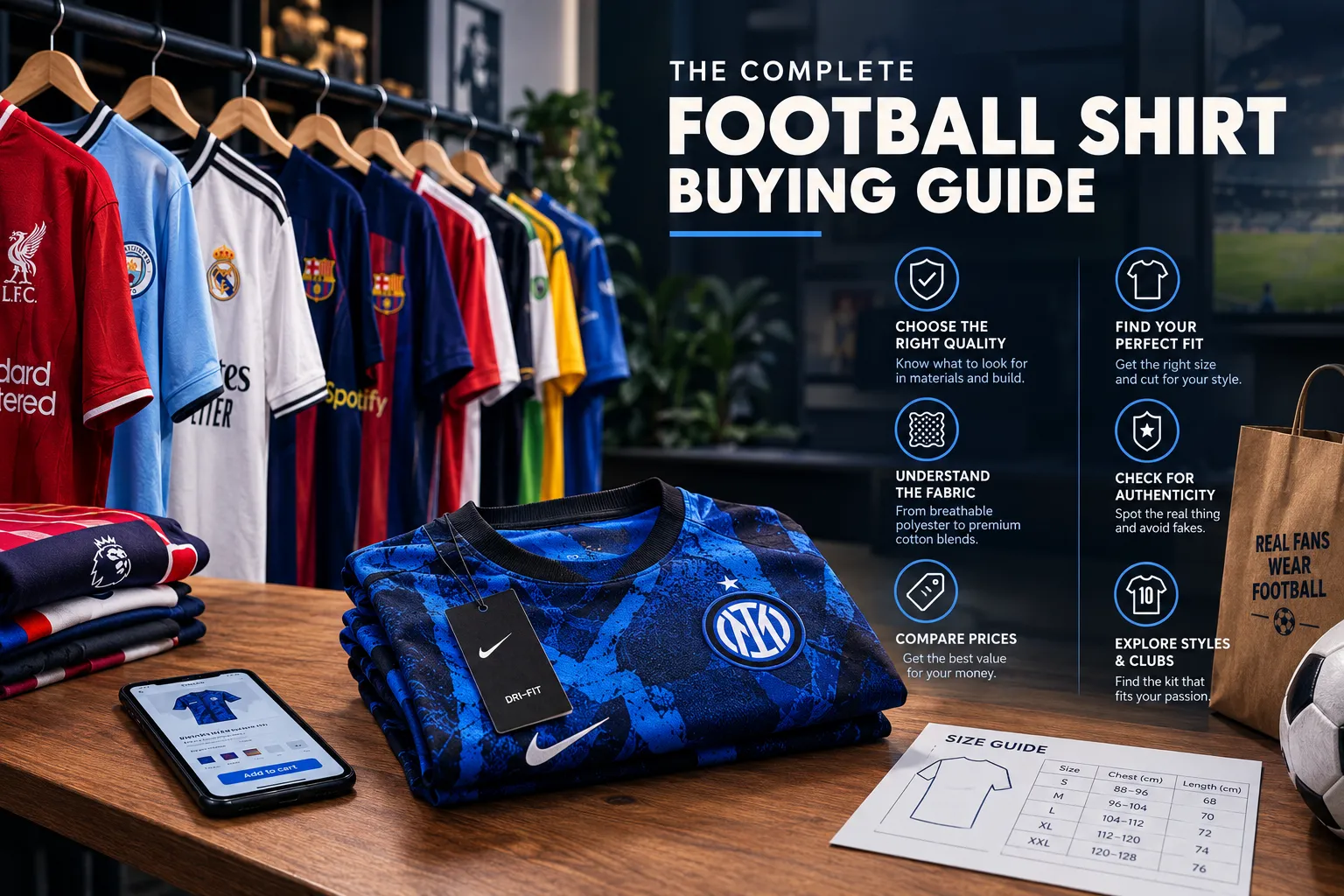
A football shirt is one of the few things people buy without really knowing what they are choosing between. Two shirts in the same club’s colours, in the same season, can differ by fifty pounds, two sizes of fit and a decade of durability, and nothing on the label explains why. Most of the regret in this market comes from not knowing which question to ask before ordering.
This guide is the short version of everything on this site. It walks through the decisions in the order you actually face them — what the shirt is for, what it should cost, which version to buy, how it will fit, which season to pick and how to avoid a bad one — and points you to the detailed guide for each step. If you only read one page before buying, read this one.
Start with what the shirt is for
Everything downstream depends on this, and it is the step most people skip. A shirt bought to wear to matches, a shirt bought to play in and a shirt bought as a gift are three different products, and the right answer changes at each.
A shirt for wearing is best served by the standard replica. It is cut generously, made from one fabric throughout, and survives a washing machine far better than the alternatives. A shirt for playing in wants the player or authentic version, which is lighter, closer cut and bonded rather than stitched at the seams. A shirt as a gift wants last season’s away or third design, because it is heavily discounted and nobody can tell at a glance.
Decide this first and half the remaining questions answer themselves.
How much should a football shirt cost?
More than people expect and less than the club shop suggests. A current-season adult replica from a Premier League club sits in a fairly narrow band, the player version runs close to double it, and last season’s equivalent falls by anywhere from a third to a half once the new design is announced.
What drives those numbers is worth understanding, because it tells you where a discount is real and where it is a worse product. Our breakdown of how much a cheap football shirt should actually cost sets out the components of the price — licensing, fabric, printing, patches — and where each one can legitimately come down.
The short version: a shirt priced well below the band for a current design is either last season’s, a lower-tier product, or not genuine. All three are fine if you know which one you are buying.
Replica, stadium or player version?
Most clubs now sell two or three tiers of the same design, and the names change by supplier. The entry replica is cut loose, uses a single fabric and has a stitched or heat-pressed badge. The top tier — player, authentic, match — is cut for a professional’s body, uses a lighter engineered fabric, and replaces stitched seams with bonded ones.
The player version is the better garment on a pitch and the worse one off it. It runs at least a size small through the chest and short in the body, it is less forgiving after a heavy wash, and the close cut that helps a winger is not what most people want on a Saturday afternoon.
If you are undecided, buy the replica. The people who regret that choice are a small minority compared with the people who bought an authentic shirt because it sounded better and found they could not move their arms.
Getting the size right
Measure, do not guess. Lay a shirt you already like flat and record three numbers: chest width armpit to armpit, body length from the centre of the collar to the hem, and sleeve length from the shoulder seam. Compare those against the seller’s measurements rather than the size letter, which means different things at different brands and in different countries.
Two specific traps. Retro reproductions are cut boxier and shorter in the sleeve than modern shirts, so your usual size will behave differently. And children’s kit is sold by age rather than measurement, with age labels varying wildly between suppliers — buy on the chest measurement where it is published, and size up rather than down.
Club by club: where to start
The general advice above applies everywhere, but each club’s range has its own quirks, and those quirks are where the value sits. The detailed guides:
Manchester United. The home shirt barely moves, which makes the alternatives the interesting part of the range. Our guide to United’s home, away and third kits compares the three, and the most iconic United jersey covers the designs with the strongest following.
Chelsea. A club whose shirt has changed more than most, which makes the season you pick matter. Start with which Chelsea season to buy, then Chelsea shirts through the decades if you are buying for the design rather than the year.
Tottenham. A fixed white home shirt and adventurous alternatives, set out in Spurs’ home, away and third range.
Leeds. All white, consistently, which means last season’s design still looks current — the single best argument for buying a season behind. Covered in our Leeds buyer’s guide.
England. The international cycle works differently from a club season, because kits are built around tournaments rather than league campaigns. Which England season to buy explains how to read it.
For two clubs whose kit history is more interesting than their current range, Everton’s kit history and Brentford’s are both worth reading before you choose a season.
Buying retro and older seasons
Retro is where the market gets genuinely difficult, because there is no single standard. A licensed reproduction, an unlicensed tribute shirt and an original from the period are three different things at three very different prices, and listings routinely blur the distinction.
The checks that matter are the badge detail, the collar construction, the number font and the fabric weight — the four things a cheap reproduction simplifies first. Our era-by-era guide to Manchester United retro shirts works through them on the most-copied range in English football, and the method transfers to any club.
One thing to accept early: a faithful retro shirt feels heavier and fits boxier than a modern one, and that is correct rather than a fault. A reproduction that feels like a current shirt has been made on a modern blank with an old design printed on it.
How do you avoid a fake or a bad reproduction?
By checking construction before appearance. Appearance is the easiest thing for a counterfeiter to get right and construction is the hardest, so the tests that work are the ones that look at how the shirt is made rather than what it looks like in a photograph.
Four that catch most problems. Stretch a patterned area gently — if colour thins and the base shows through, the pattern is printed rather than knitted. Hold the badge at arm’s length and see whether the fine detail inside it is distinct. Turn the shirt inside out and look at whether the neck tape, seams and labels are finished squarely and consistently. And check the number font against an official image, because the league fonts are specific enough that a near-match is obvious.
Our full list of what to check before buying a cheap football shirt runs through the rest, including the questions worth asking a seller before you commit.
Buying online in the UK
Almost all of this now happens online, which removes the ability to try anything on and makes the seller part of the product. What you want is photographs of the actual item rather than stock images, at least one showing the inside of the neck, a clear returns policy and a seller with trading history.
Delivery and returns matter more than the headline price. A shirt five pounds cheaper from a seller with no returns process is not cheaper, because the sizing risk is yours. Our guide to buying football kits online in the UK covers duties, delivery times and what a reasonable returns window looks like.
If you are buying cheap football shirts online for the first time, the single most useful habit is to order from somewhere that will take the shirt back. Everything else is recoverable.
Beyond the shirt
Part of the pleasure of buying a kit is knowing what the people wearing it are actually doing. If you want the football rather than the garment, the rest of this site covers it: why the number 10 still matters, what makes a great Premier League full-back, how pressing changed the Premier League and why the counter-attack survives in spite of it.
On the season as a whole, we look at why promoted clubs struggle, why the relegation battle starts in August and why clubs sack managers mid-season. And on the players themselves, why strikers go through goal droughts and what makes a good penalty taker are the two that most often get explained badly elsewhere.
For fixtures, squads and official club information, the Premier League’s own site is the reliable source.
Frequently asked questions
When is the cheapest time to buy a football shirt?
The weeks immediately after the following season’s home kit is announced, usually in late spring. Away and third shirts start falling around the turn of the year; home shirts hold their price until they are replaced.
Is the player version worth the extra money?
Only if you are going to play in it. It is lighter, closer cut and better engineered for movement, but it is sized for an athlete and less comfortable for ordinary wear. Order a size up if you buy one.
How do I know which season a shirt is from?
Use the sponsor first, then the supplier’s logo, then the crest treatment and the collar shape. Those four together will place almost any shirt within a season or two, and a listing where they disagree is a listing to avoid.
Are competition sleeve patches included when you buy a shirt?
Usually not. Patches are licensed separately and are normally an optional extra applied at the point of sale, as is official name and number printing. Budget for both if you want them.
Leave a Reply