
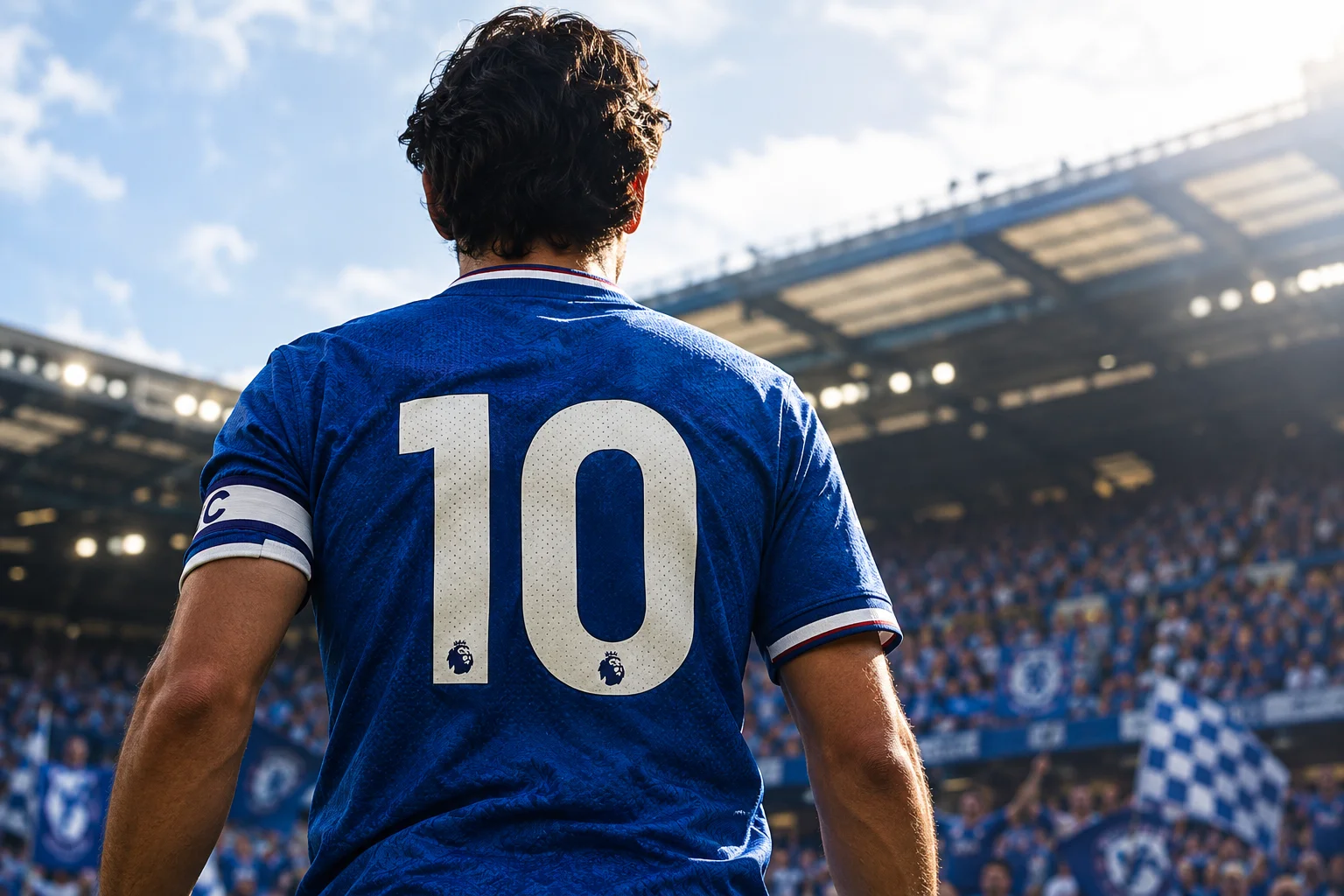
For much of football’s history, the number 10 was the most important shirt on the pitch. It belonged to the player who made the team play, the one given the ball in tight spaces and trusted to do something with it. Some of the greatest players the game has produced wore it, and the number became shorthand for a particular kind of talent.
Then tactics changed, and for a while it looked as though the classic number 10 had been coached out of existence. The truth is more interesting. The number stayed. The role moved.
What did the number 10 originally mean?
It comes from the old positional numbering, where the forwards wore seven to eleven and the inside-left, the more creative of the two inside-forwards, wore ten.
Over time that position evolved into the playmaker, the player who operated between midfield and attack and linked the two. The number 10 was expected to see passes others could not, to hold the ball under pressure, and to produce moments that changed matches. Defending was somebody else’s job.
That freedom is what made the role so appealing to supporters and so difficult for opponents. A great number 10 could decide a game in a few seconds.
Why did the classic number 10 disappear?
Because modern tactics stopped tolerating a player who did not defend.
As pressing became the dominant defensive approach, every player was expected to contribute when the team lost the ball. A number 10 who stood still while the rest of the side ran left a hole that well-organised opponents exploited immediately. Coaches began to prefer attacking midfielders who worked as hard without the ball as with it.
Formations shifted too. The space between the opposition’s midfield and defence, where the number 10 lived, was squeezed by compact defensive shapes. The player who thrived on finding that pocket found there was less of it to find.
Where did the role go?
Everywhere, is the honest answer. It was spread across the team rather than removed from it.
The creative burden the number 10 once carried alone is now shared. Wide forwards drift inside to occupy the spaces the playmaker used to. Deep-lying midfielders dictate the tempo from further back. Full-backs arrive in the final third to provide the width that frees up central space. The passes the number 10 used to play still get played, just by more people from more positions.
Some managers have also brought the role back in a more modern form, with attacking midfielders who create in the traditional way but press aggressively when possession is lost. That combination is rare, which is why players who can do both are so valued.
Did the number 10 exist in every football culture?
The idea did, though it went by different names.
In South America the number 10 became almost sacred, associated with the most gifted players the continent produced. In Italy the role was the fantasista, the player permitted to improvise where others followed instructions. In England it was often called the playmaker or the inside-forward, and English football was historically more suspicious of it, preferring players who worked. That suspicion is one reason the classic number 10 was rarer in England than elsewhere, and why the ones who did emerge were so celebrated.
Does the number itself still carry weight?
Yes, and at many clubs it carries more than it should.
Because of who has worn it, the number 10 shirt comes with expectations. A player handed it is expected to be the creative centre of the side, and supporters judge them against the players who wore it before. That can be a burden as much as an honour, and plenty of players have struggled under it.
Some clubs use the number carefully, giving it only to a player they believe can carry it. Others treat it as just another squad number. The reaction from supporters when it is given to an unexpected player tells you which kind of club you are watching.
Why do some managers refuse to play one?
Because the role, in its classic form, asks the rest of the team to cover for a player who does not defend. A manager whose system depends on every player pressing cannot afford a passenger, however gifted. Those managers tend to convert their most creative player into a wide forward or a deeper midfielder, where his talent is used but his defensive duties are clearer.
How has the modern number 10 changed?
The defining shift is that the modern version has to run.
Today’s attacking midfielders cover far more ground than their predecessors, pressing from the front, tracking runners and dropping into midfield when the shape demands it. They still need the technical qualities of the old number 10, but those qualities now come attached to a physical output the classic playmaker was never asked for.
The result is a player who is harder to find and more valuable when found. A creative midfielder who also works at the intensity modern football requires can play in almost any system.
Which clubs guard the number most carefully?
The ones with the longest history of great players wearing it.
At some clubs the number 10 has passed down a line of celebrated players and become part of the club’s identity. Handing it to a new signing is a statement that the club believes he belongs in that line, and handing it to the wrong player invites years of unfavourable comparison. Managers at those clubs sometimes leave the number unassigned for a season rather than give it to someone who cannot carry it.
Elsewhere the number is treated more casually, and that says something about the club’s history too. A club without a famous number 10 in its past has no tradition to protect.
Why supporters still want one
Because the number 10 represents the part of football that cannot be coached.
Systems, pressing schemes and set-piece routines can all be drilled. The ability to see a pass nobody else has seen, or to beat a player in a space that did not appear to exist, cannot. Supporters are drawn to that quality for the same reason they always were, and the number 10 remains the shirt most associated with it.
The number 9 carries its own expectations, as does the goalkeeper’s number 1, and our piece on how pressing changed the Premier League covers the tactical shift that changed all of them.
It is worth watching for on a matchday. Find the player the others look for when they are in trouble, the one given the ball in tight spaces and trusted to keep it. Whatever number he wears, that is the number 10.
Frequently asked questions
What position is the number 10 in football?
Traditionally the attacking midfielder or playmaker, operating between midfield and attack and responsible for creating chances.
Why is the number 10 so famous?
Because many of the game’s greatest creative players wore it, and the number became a symbol of the playmaker role itself.
Do modern teams still play with a number 10?
Many do, though the role has changed. Modern attacking midfielders are expected to press and defend as well as create, which the classic number 10 was not.
Leave a Reply