
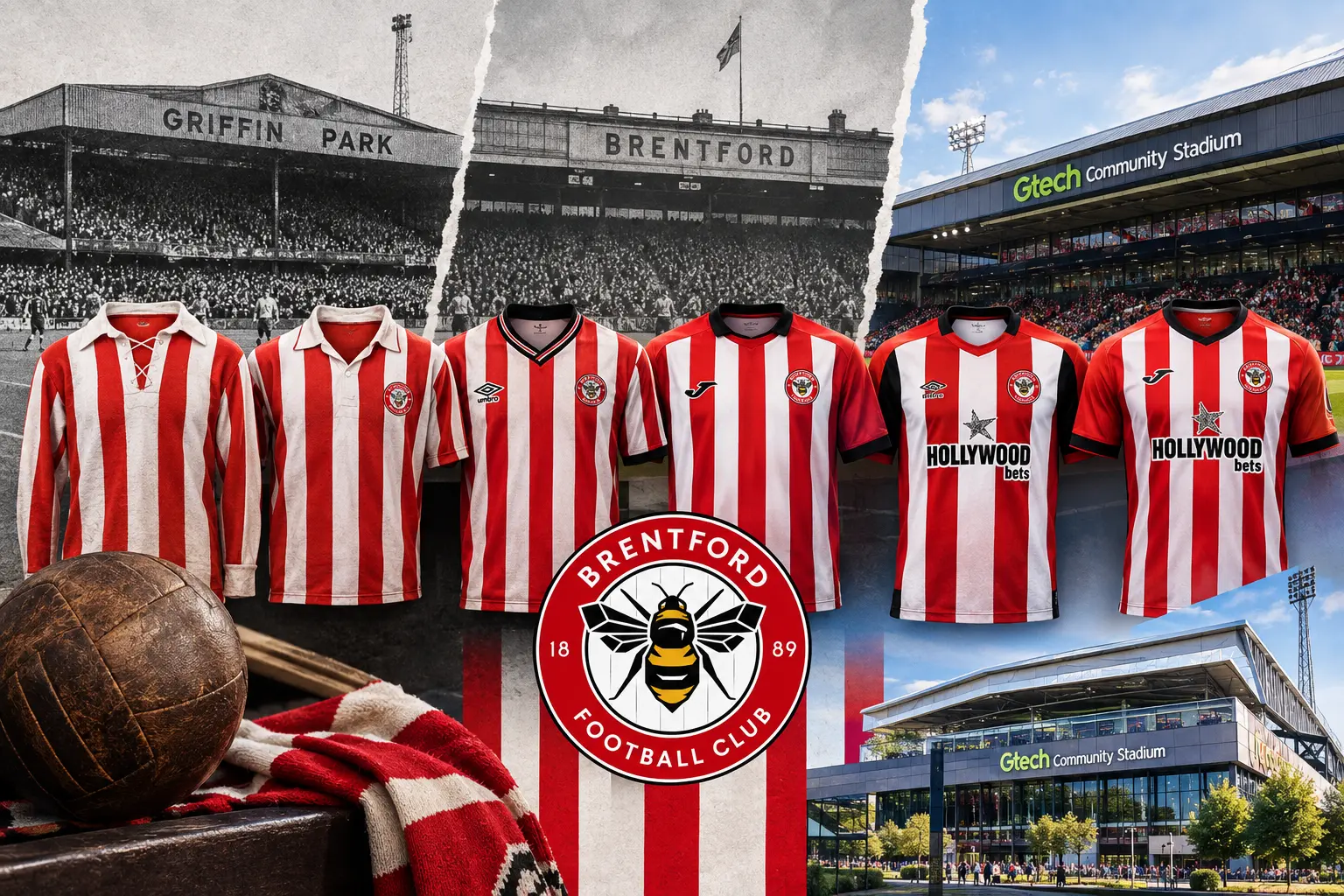
Brentford have worn red and white stripes for a century, which is long enough that the stripes now feel like the whole point. They were not always. For the first three decades of the club’s existence the colours changed almost as often as the league position, and the decision that fixed them in 1925 was taken by a club still finding its feet in the Football League. This is the story of the Brentford kit: the grounds it was worn at, the promotions it was worn for, and how the modern version came to be one of the most sensibly managed shirts in the Premier League.
Claret, salmon and a decision in 1925
Brentford were formed in October 1889 by members of Brentford Rowing Club who wanted a winter sport, and the early kits borrowed from the rowing club’s colours: claret, light blue and salmon, in combinations that would not survive a modern brand review. Blue and white followed. It was only in 1925 that the club settled on red and white vertical stripes with black shorts, and it has barely wavered since. The nickname, the Bees, is older and has nothing to do with the kit. The story goes that supporters from Borough Road College would shout “Buck up Bs” from the terrace, and the local press turned it into something friendlier.
Griffin Park: a pub on every corner
The stripes were worn at Griffin Park from 1904 until 2020, a ground famous for having a pub on each of its four corners and for being one of the last true neighbourhood stadiums in the capital. It was where Brentford’s greatest early era was played out. Promoted to the First Division in 1935, the club finished fifth in 1935/36, still the best league finish in its history, and stayed in the top flight until relegation in 1947. For most of the seventy years that followed, the red and white stripes were a lower-league sight.
The long road back
Brentford dropped into the Fourth Division in 1962 and spent the best part of five decades moving between the bottom two tiers, with the occasional near miss. Matthew Benham, a lifelong supporter who had made his money in sports betting, took control in 2012 and did something no other English club owner had really tried: he built the entire football operation around data. Promotion to the Championship followed in 2014, and the appointment of Thomas Frank as head coach in 2018 gave the project a coach who understood it and could sell it to players.
A new ground and the day at Wembley
In 2020 the club left Griffin Park for the Brentford Community Stadium beside Kew Bridge, renamed the Gtech Community Stadium in 2022, a compact ground of just over 17,000 seats built with the same discipline as the recruitment. It very nearly happened a year earlier: Brentford lost the 2020 play-off final to Fulham behind closed doors that August, a defeat that felt at the time like the end of the project. It turned out to be the rehearsal. The first season at the new ground ended at Wembley. On 29 May 2021 Brentford beat Swansea City 2-0 in the Championship play-off final, Ivan Toney converting an early penalty and Emiliano Marcondes adding the second, to reach the top flight for the first time since 1947. Three months later, in their first ever Premier League match, they beat Arsenal 2-0 at the Gtech on the opening night of the season.
The bee on the chest
The crest changed more recently than the stripes. For decades Brentford wore a shield-shaped badge crowded with a bee, red and white stripes and a good deal of heraldry, and in 2017 the club replaced it with a simple roundel: a single bee, the club name and the founding year. Supporters were nervous about losing the old shield, but the roundel has aged well, sits cleanly on a striped shirt and now looks as though it has always been there. It was also, quietly, a sign of a club preparing to be seen by a much bigger audience.
The modern Brentford kit
Umbro made Brentford’s kits from 2018 until 2026, when Joma took over for the new two-season cycle, and the home shirt has stayed loyal to the template: red and white stripes, black shorts, black socks, with the manufacturer allowed to play with stripe width, collar shape and the odd pinstripe. The away and third kits are where the club experiments, and recent seasons have produced designs in everything from navy to lilac to a much-debated shade of green. The shirts of the Ivan Toney years, 2021 to 2024, are already being treated as classics by supporters who watched him score twenty league goals in 2022/23 as Brentford finished ninth in only their second top-flight season.
The Joma design adds honey-yellow accents, a nod to the bee. What makes the current shirt unusual is its lifespan. When Premier League clubs released their 2026/27 kits over the summer, Brentford were the only club to announce that the home shirt would remain current for two seasons rather than one. At £65 it is also among the cheapest adult shirts in the division, with only Hull City charging less. For a club that has spent a decade proving it thinks differently, a shirt you are not asked to replace every twelve months is entirely in character, and it is the sort of decision supporters remember.
From Frank to Andrews
The summer of 2025 tested the model as hard as anything since promotion. Frank left for Tottenham, and Bryan Mbeumo, Yoane Wissa and captain Christian Nørgaard followed him out of the door, to Manchester United, Newcastle and Arsenal respectively. Set-piece coach Keith Andrews was promoted to head coach in June 2025, in his first managerial job, and most observers expected a relegation fight. Instead, Brentford finished ninth, equalling the best Premier League finish in the club’s history, with Igor Thiago and Michael Kayode among the standout performers and wins over both Manchester United and Liverpool along the way. Andrews signed a new long-term contract in February 2026, and the 2026/27 season opened with a 3-0 win over Tottenham at the Gtech, which will have been noted in the away dugout.
Why the stripes matter
There are more famous kits in the Premier League, and there are certainly more expensive ones. But the Brentford shirt is a rare thing in modern football: a design that has been left alone for a hundred years, worn by a club that has grown without pretending to be something it is not. The stripes have been to Wembley, they have beaten Arsenal and Liverpool, and they are now in their sixth consecutive season in the top flight. Griffin Park is housing now, its four pubs the only reminder of what stood there. The stripes are still here. For more Premier League news, match reports and club stories, visit ST Domingos.
Leave a Reply