
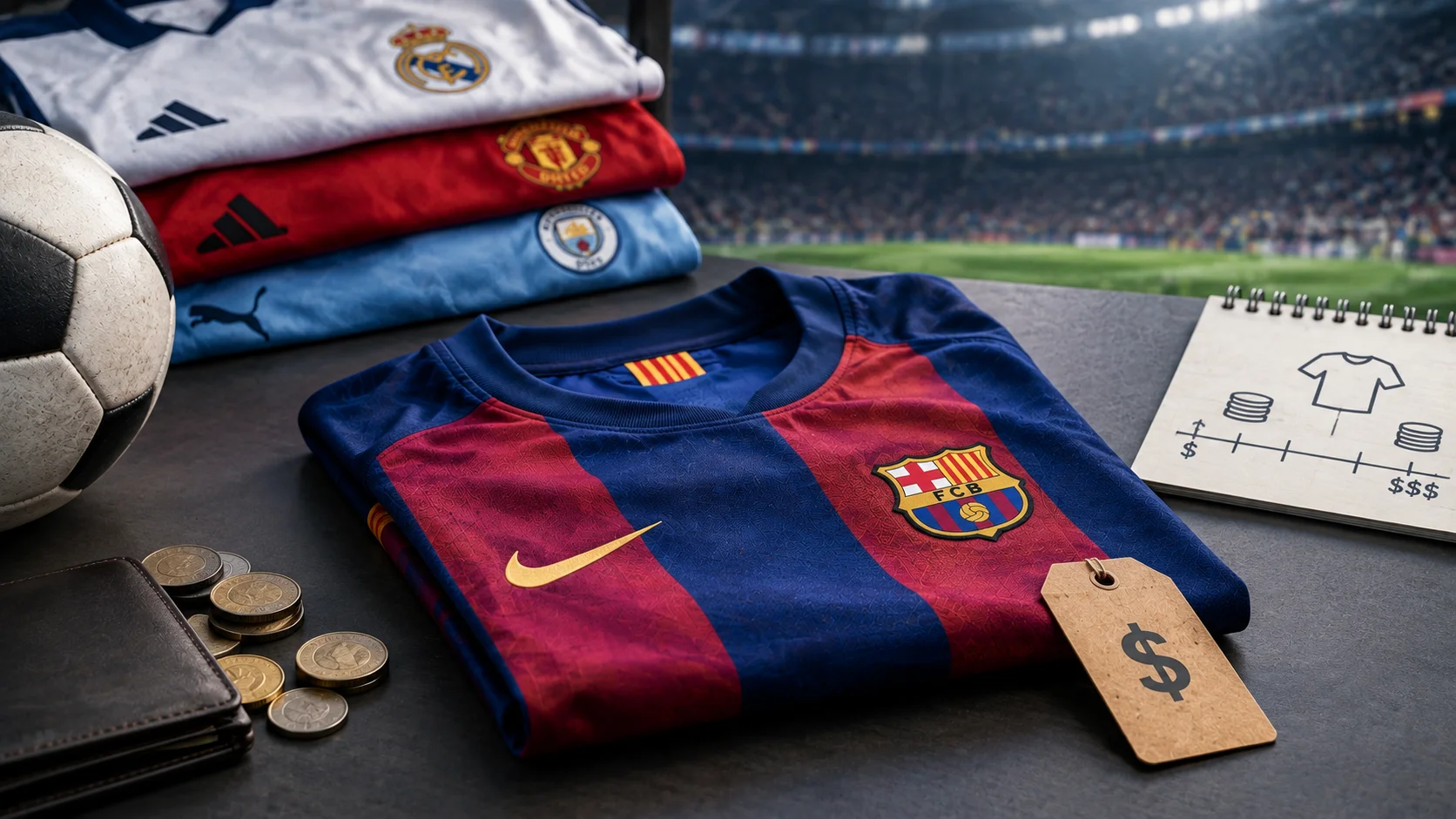
A replica football shirt is polyester, stitching, a crest and a sponsor. The manufacturing cost is not a secret and it is not high. Yet the price on a club shop shelf has climbed steadily for two decades, and each summer brings another round of complaints when the new kit is announced.
Understanding where that money actually goes is genuinely useful, because it tells you which parts of the price are buying you quality and which parts are buying you something else entirely.
What are you actually paying for?
Very little of a shirt’s price is the shirt.
The largest components are licensing and the commercial arrangements behind the kit. A manufacturer pays a club a substantial sum for the right to make and sell its shirts, the club sells sponsorship space on the front, and the retail price has to support all of that before anything reaches the person who made the garment. Marketing, distribution and retail margin sit on top.
The polyester, the stitching and the crest are a modest fraction of the total. Which is why two shirts of genuinely similar construction can sit at very different price points, and why the expensive one is not automatically better made.
Why can cheap shirts match expensive ones?
Because the thing that makes the expensive shirt expensive is mostly not present in the garment.
A well made replica uses the same category of recycled polyester knit, the same basic construction methods and the same crest attachment techniques. What it lacks is the official licence. That is a legal and commercial distinction rather than a quality one, and it accounts for most of the price gap.
This is why people looking for cheap football shirts are not necessarily trading down. They are declining to pay the licensing premium. Whether that is the right call depends on whether the licence itself matters to you, which is a fair thing to want and a separate question from quality.
What does a cheap shirt actually give up?
Sometimes nothing meaningful. Sometimes quite a lot. The variation is between sellers, not between price brackets.
At the bad end you find heat pressed crests that lift within months, fabric light enough to show shadow through it, stitching sparse enough to fail at the hem, and colour that misses the intended shade. Those are real defects and they are worth avoiding.
At the good end you find a shirt that is difficult to distinguish from an official one at conversational distance, holds up through a season of washing, and cost a third of the price. Both exist at similar price points, which is why the seller matters more than the number.
How do you tell which one you are looking at?
Three checks, all possible from a listing.
The crest first. Embroidered or properly bonded crests survive years of washing. Heat pressed badges lift at the corners and then keep lifting. A seller who photographs the crest close up is telling you they are not worried about it.
Then stitching at the hem and sleeve cuffs, which take the most stress on the garment. Even and dense is what you want. Then fabric texture, visible in any reasonable close up — match specification shirts use a light knit with structure and often mesh panels, while a completely smooth flat surface indicates a cheaper base cloth.
A seller using only manufacturer render images, with no detail shots and no measurements, is asking you to take it on trust. That is information in itself.
Does the season affect what you should pay?
Substantially, and this is where most of the available savings sit.
New kits arrive in summer at full price and hold it through the opening months. Reductions start after the new year and become serious in spring, when sellers clear stock ahead of the next release. The same shirt can move a long way across those twelve months without changing at all.
Which makes last season’s kit the best value item on the market at almost any point. Twelve months old, near identical to anyone not inspecting the collar, and meaningfully cheaper. Unless being current is specifically the point, it is hard to argue for paying the premium.
What about shipping, printing and the rest?
A good headline price can stop being good by the time you reach the checkout.
Shipping is frequently charged per item, with a reduced rate for additional items in the same order. If you are buying more than one shirt over a few months, ordering together often saves more than any discount code. Watch free delivery thresholds too.
Printing adds cost and removes your ability to return the shirt, since it has been made to your specification. If the shirt ships from outside the UK, duty and courier handling fees may arrive separately after delivery. None of these are hidden, but they are easy to skip past.
Does where the shirt ships from change the price?
It changes the total, which is the number that actually matters.
A shirt shipping from UK stock arrives without customs complications and usually faster. A shirt shipping from abroad may be cheaper on the listing and then attract duty plus a courier handling fee on arrival, which can close the gap entirely or reverse it.
Sellers who state plainly that duties are included, or who ship domestically, are removing a variable from your calculation. That certainty is worth paying a little for, particularly on a first order with a seller you have not used before.
So what is a fair price?
For a well made replica of a current season kit, considerably less than a club shop charges and considerably more than the very cheapest listings you will find. The bottom of the market is cheap for reasons that show up in the crest and the stitching.
The most reliable way to buy well is to ignore the headline number entirely for a moment, run the three checks, and then compare prices only among the shirts that pass. The football business coverage at the Guardian is a reasonable place to follow how the commercial side keeps moving, since it is what sets these prices in the first place.
Buying a full kit rather than a single shirt changes the maths again — our guide to ordering football kits online in the UK covers the practical side. And for the club by club checks in more detail, our piece on what to check before buying cheap football shirts goes step by step.
Frequently asked questions
Why are official football shirts so expensive?
Most of the price covers licensing agreements between manufacturers and clubs, plus marketing, distribution and retail margin. The materials and construction account for a comparatively small share.
Are cheap football shirts worse quality?
Not automatically. Well made replicas use comparable fabric and construction, and the price difference largely reflects licensing rather than materials. The variation that matters is between good and bad sellers.
When is the cheapest time to buy a football shirt?
Late spring, as sellers clear stock before the next season’s release. Buying the previous season’s shirt at any point in the year is usually cheaper still.
Leave a Reply