
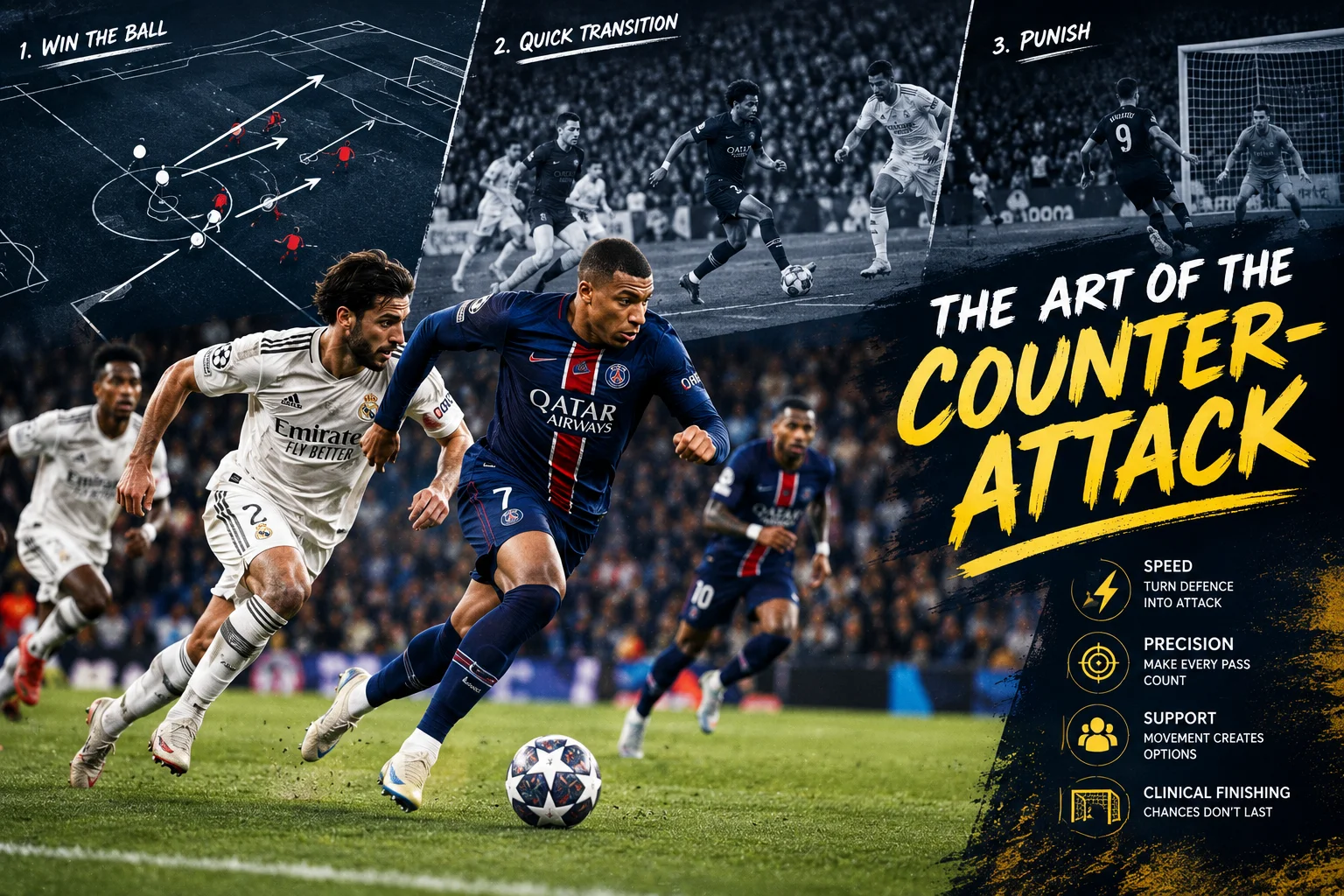
The counter-attack is the tactic that lets a worse side beat a better one, and it has been doing so for as long as football has existed. Let the opponent have the ball, absorb their pressure, win it back, and attack the space they left behind before they can recover. It is simple to describe and extremely hard to do well, and the sides that master it have won titles with far less talent than their rivals.
This is how it works, what it demands, and why it still works in an era of pressing and possession.
What is a counter-attack?
An attack launched in the moments immediately after winning the ball, into space the opponent has left by attacking.
When a side commits players forward, it thins out its own defence. If it loses the ball at that moment, the opposition can attack a defence that is out of position, with fewer defenders than there would be against a settled attack. The counter-attack exploits that window, which lasts only a few seconds before the defending side recovers its shape.
Speed is the whole thing. A counter that takes ten seconds to develop is not a counter. It is an attack against a defence that has got back.
Why does it work against better sides?
Because better sides have the ball more, and having the ball is the risk.
A dominant possession team spends most of the match in the opponent’s half, with its full-backs high and its midfielders forward. Every pass it plays is an opportunity to lose the ball, and every time it does, the space behind its advanced players is exposed. A side that defends deep and compact invites that pressure precisely because it wants the ball lost in those positions.
The arithmetic favours the counter-attacking side on each individual turnover, even though it is the weaker team overall. That is why counter-attacking has produced so many famous upsets.
What does it demand of the players?
Discipline without the ball and pace with it.
The defensive phase requires patience. Players have to hold their shape, resist the urge to press and win the ball back on their own terms, often for long stretches while the opponent passes around them. That is mentally draining and it is where most counter-attacking sides fail, by losing concentration before the chance arrives.
The attacking phase requires speed, in the pass and in the run. Forwards who can cover ground quickly, midfielders who can play one accurate pass under pressure, and the judgement to know when the window is open. A counter-attack with the wrong pass or the wrong run collapses before it starts.
How is it structured?
Around the first pass after the ball is won, and the runs already in motion when it is played.
The best counter-attacking sides have forwards who begin their runs before the ball is recovered, reading the turnover a second early. The player who wins the ball looks forward first, not sideways. The pass goes into space ahead of the runner rather than to feet. Within three or four passes the ball is in the opponent’s penalty area, against a defence that was thirty metres further forward moments earlier.
Everything is rehearsed. Counter-attacking looks spontaneous, but the patterns are trained until they are automatic.
Why do supporters love a counter-attack?
Because it is football at its fastest, and because it rewards the underdog.
A counter-attack goal is often the most exciting kind: the ball won deep, three passes, a sprint and a finish, inside ten seconds. It also carries a moral satisfaction when the weaker side scores it, since it represents the better team being punished for its ambition. Few moments in football produce the same noise from an away end.
Has pressing killed it?
No, though it has changed how it is used.
Pressing sides try to win the ball high and attack immediately, which is a counter-attack of its own kind, launched from the opponent’s half rather than your own. Many modern teams combine the two, pressing when the conditions suit and dropping into a compact shape when they do not. Our piece on how pressing changed the Premier League covers the tactic that was supposed to make counter-attacking obsolete and instead absorbed it.
What pressing has done is raise the cost of possession. A side that keeps the ball under a high press is taking risks constantly, which means more turnovers and more chances to counter. The tactic that dominates and the tactic that exploits it have grown together.
Why do struggling sides lean on it?
Because it suits the resources they have.
A side without the players to dominate possession can still defend in a block and run quickly. Counter-attacking asks for organisation, discipline and pace, none of which require a large budget. It also produces results against the stronger sides in the league, which is where a struggling club needs points it was not expected to get.
Our piece on why the relegation battle starts in August covers how sides at the bottom plan their seasons, and the counter-attack is usually part of it.
Which positions matter most in a counter?
The forwards for pace and the first passer for judgement, which is often a deep midfielder or a centre-back.
The player who wins the ball and plays the first forward pass is the one the whole move depends on, and he is rarely the one who gets credit. A centre-back who can intercept and immediately find a runner forty metres away is worth more to a counter-attacking side than a second striker. The forwards, meanwhile, need the pace to exploit the space and the composure to finish at the end of a sprint, which is a harder combination than it sounds.
What separates good counter-attacking from bad?
Decision-making in the first two seconds.
Winning the ball is only the start. The player who wins it has to see the right pass instantly, and the runners have to be moving before he looks up. Sides that counter well make those decisions as a unit, with everyone reading the same picture. Sides that counter badly win the ball and then pause, by which time the opponent has recovered and the moment has gone.
The great counter-attacking teams make it look easy because the hard part, the decision, has been made before the ball arrives.
Watch for it next time a smaller side plays one of the top clubs. The moment the ball is won, look at the forwards rather than the ball. If they are already running, the counter was coached. If they are waiting, it was not.
Frequently asked questions
What is a counter-attack in football?
An attack launched immediately after winning the ball, into the space the opponent has left by committing players forward, before they can recover their defensive shape.
Why do counter-attacks work against stronger teams?
Because stronger teams have the ball more and attack with more players, which leaves them exposed each time they lose possession.
Is counter-attacking a defensive tactic?
It requires a disciplined defensive phase, but the aim is to score. The deep defending is the setup; the fast attack is the point.
Leave a Reply