
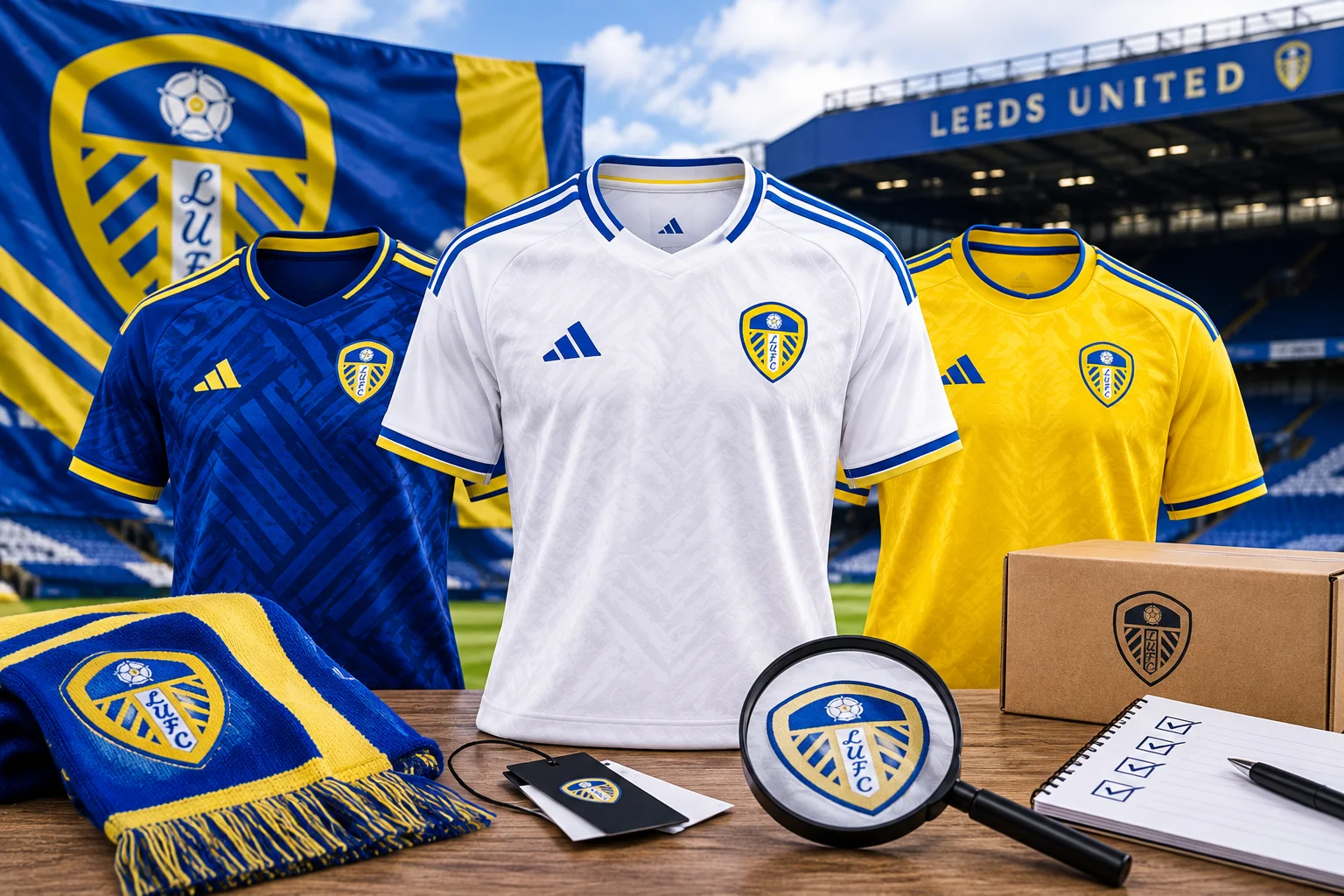
White is the most difficult kit colour to buy cheaply, and it catches people out constantly. A red shirt that is slightly the wrong red still looks like a red shirt. A white shirt that is slightly off looks grey, or cream, or simply cheap, from across a room.
Leeds have worn white since the 1960s, which makes their shirts both instantly recognisable and unusually unforgiving of poor production. That is worth understanding before you order.
Why white is the hardest colour to produce well
White fabric shows everything. Uneven dye uptake, inconsistent fabric weight, thin patches in the knit, and any variation between panels are all visible in a way they simply are not on a coloured shirt.
It also shows wear fastest. White polyester picks up a grey cast after repeated washing if the fabric quality is poor, and it does not come back. A good white shirt stays white for years. A bad one is visibly tired within a season.
So when you are comparing listings for cheap leeds shirts, white is doing you a favour: the faults that would be hidden on another club’s kit are right there in the photograph if you look.
What should you check in the product photos?
Start with panel consistency. Look at where the sleeve joins the shoulder and whether the two whites match exactly. Look at the collar and any trim. On a well made shirt these are identical. On a poorly made one there is a visible difference in tone.
Then look for opacity. A white shirt photographed on a mannequin should not show shadow through the fabric at the shoulders or across the chest. If it does, the knit is too light, and that shirt will look thin in person and worse after washing.
Finally, the crest and any badge work. Against white, a heat pressed crest with a visible backing square is obvious in a way it never is on a dark shirt. Embroidered or properly bonded crests do not have that problem.
Do the yellow and blue trims matter?
More than you might expect, because they are where a cheap reproduction usually gives itself away.
Leeds shirts have used yellow and blue as accent colours across most of their modern history, in collars, sleeve cuffs and side panels. Those accents are small areas of strong colour against white, which is exactly the situation where poor dyeing bleeds. Look closely at the boundary between the trim and the white. It should be sharp.
Bleeding at that edge is a reliable sign of a shirt that will deteriorate quickly in the wash, since the same dye instability that caused the bleed will keep causing it.
Which Leeds seasons are worth buying?
The shirts people return to tend to be the ones where the design did something specific rather than following the template of the year.
Shirts with a distinctive collar treatment stay recognisable, since the collar is the element that changes most between seasons. Shirts from years with an unusual sponsor are easy to place and were made in smaller numbers. And shirts tied to a season people remember carry meaning that has nothing to do with the garment.
Against that, a plain white shirt from an unremarkable season with a long running sponsor is difficult to date and difficult to get excited about. It is also, usually, the cheapest option available, which may be exactly what you want.
Home or away: which Leeds shirt should you actually buy?
The home shirt is the club’s identity and the obvious purchase, but it is also the one that changes least. White with yellow and blue accents, year after year, with variation confined to the collar and trim. That consistency is the point, and it means a home shirt from four seasons ago still looks entirely current to most people.
Away shirts carry more risk and more reward. Leeds have used yellow, blue and various darker options over the years, and because those kits change more dramatically they stay distinctive for longer. They are also produced in smaller quantities.
If you want the shirt that says Leeds at a glance, buy white. If you want something that will still feel like a deliberate choice in five years, look at the away kits first.
How do you keep a white shirt white?
This matters more here than at any other club, and most of the damage people do is avoidable.
Wash cool at thirty degrees and turn the shirt inside out first, which protects the crest and any printing. Wash it with other whites rather than in a mixed load, because white polyester picks up colour transfer readily and does not release it.
Stay away from the tumble dryer entirely. Heat is what lifts heat pressed crests and cracks printed numbers, and on white it also accelerates yellowing. Air drying costs nothing and makes a substantial difference over a few years.
Skip fabric softener. It coats the fibres, dulls the white and reduces the breathability that makes the fabric work in the first place.
Getting the sizing right
The standard method applies. Take a shirt you already own and like the fit of, lay it flat, and measure across from one armpit seam to the other. Match that half chest figure to the seller’s chart rather than picking the letter you usually wear.
One consideration specific to white: a shirt that fits closely shows more through the fabric than a darker shirt would. If you are between sizes, the larger of the two is generally the safer choice on a white kit.
Is a cheap Leeds shirt a good buy?
Yes, provided you use the fact that white hides nothing. Check panel consistency, check opacity, check the trim edges for bleed, and check how the crest is attached. All four are visible in decent photography before you pay anything.
Then wash it properly and it will still look right in three years, which is the whole point.
Once you know what to check, the next question is what a shirt should actually cost — our piece on how much a football shirt is really worth breaks the pricing down. For how another club’s kit identity was shaped by a stadium move, Everton’s kit history from Goodison to Bramley-Moore Dock covers similar ground.
Frequently asked questions
Why do cheap white football shirts look grey?
Usually poor fabric quality or colour transfer in the wash. Low grade white polyester picks up a grey cast after repeated washing, and washing with coloured items accelerates it considerably.
How do I stop a white shirt yellowing?
Wash cool, with whites only, and air dry rather than tumble drying. Heat is the main cause of yellowing in polyester, so keeping the shirt out of the dryer is the single most effective thing you can do.
How do I know a white shirt is thick enough?
Look for shadow showing through the fabric in photographs taken on a mannequin, particularly at the shoulders and across the chest. If you can see the form underneath, the knit is too light and the shirt will look thin in person.
Are Leeds away shirts a better buy than the home kit?
They hold their distinctiveness longer, since the home kit is always white and changes little between seasons. Away shirts vary more and are made in smaller numbers, which is what keeps them interesting.
Leave a Reply