
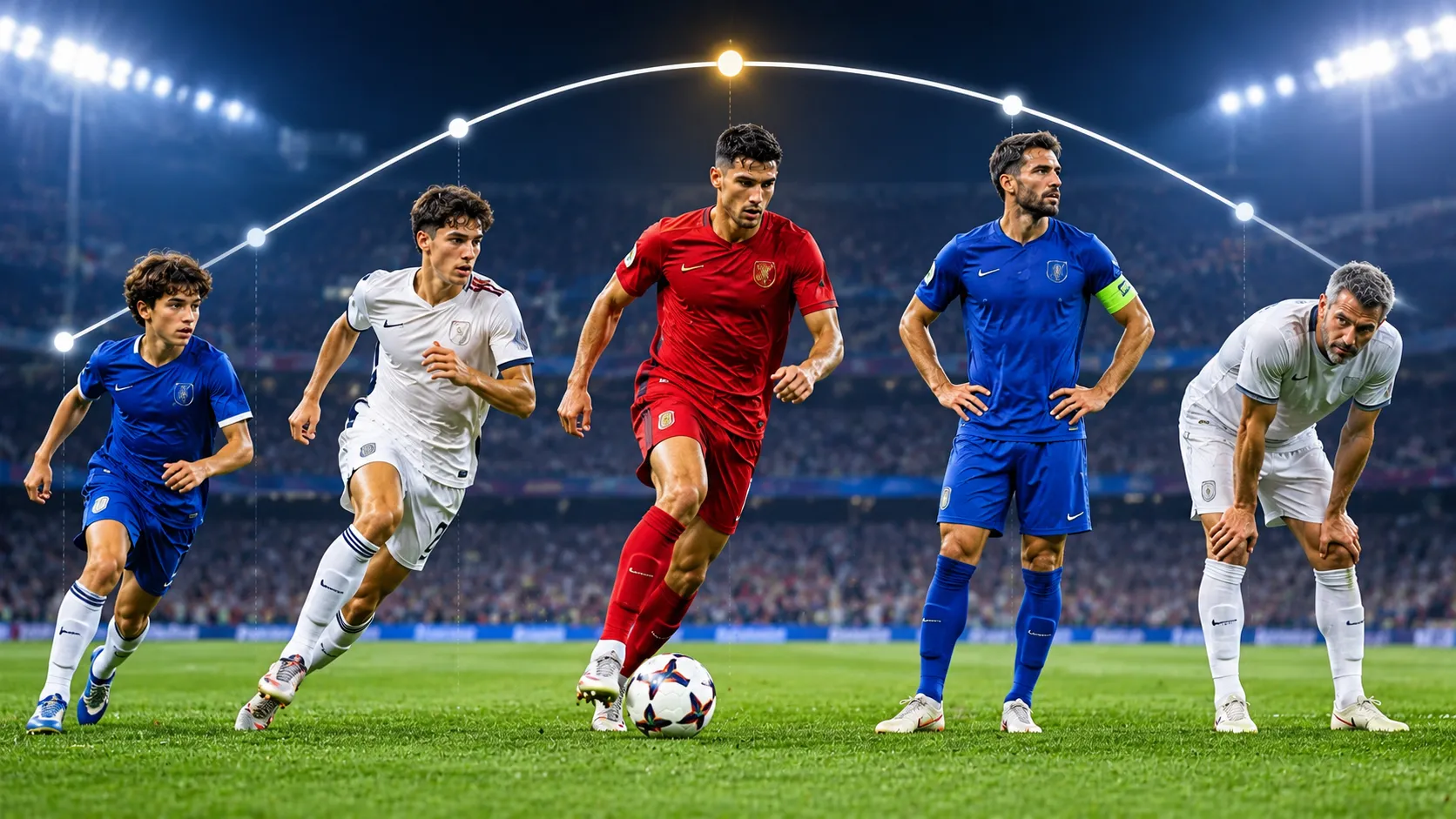
Understanding why footballers peak at different ages starts with accepting that there is no single peak. A sprinter-winger, a holding midfielder and a goalkeeper are doing jobs with almost nothing in common physically, and the ages at which each is at his best differ by as much as a decade.
The general curve is well established a broad peak somewhere in the late twenties but the general curve describes nobody in particular, and the variation around it is where the useful information sits.
The physical curve, in outline
Maximum sprint speed and explosive power peak early, typically in the early to mid-twenties, and decline steadily from there. Endurance and repeated-sprint capacity hold up considerably longer, into the early thirties with good conditioning.
Strength peaks later than speed, usually late twenties. And the things that do not decline at all until much later positional judgement, anticipation, technique, composure are precisely the ones that take longest to acquire.
That mismatch is the whole explanation. A player whose value depends on acceleration has a short window; a player whose value depends on reading the game has a long one, and the long one gets better for years after the short one has closed.
Position by position
Wingers and forwards who play on the shoulder of the last defender peak earliest, because the thing they sell is separation over five yards. When that goes, it goes relatively quickly, and the players who last are the ones who had something else as well.
Central midfielders peak in the middle of the range, late twenties, because the role balances physical output against decision-making. Holding midfielders can extend considerably longer by reducing the distance they cover and increasing the accuracy of where they stand.
Centre-backs peak latest among outfield players, frequently around thirty, and good ones play well past it. The job rewards positioning, timing and aerial ability none of which declines sharply and punishes a loss of pace less than people assume, because a defender who reads the pass does not need to recover from being beaten.
Goalkeepers are a category apart, often at their best in their mid-thirties, because reflexes decline slowly and everything else about the position improves with experience.
Why does a loss of pace matter less than it looks?
Because pace is used to solve problems that experience can prevent. A defender who is two yards slower than he was but stands two yards better off is in the same place at the same time, and he has done it with less effort.
That substitution has limits. A centre-back who has lost significant pace is exposed by balls in behind in a way positioning cannot fully cover, which is why ageing defenders often move to sides that defend deeper. The adjustment is real and it is a change of context rather than a decline in ability.
Forwards have less scope for it. A striker can drop deeper and link play, and plenty have extended careers that way, but the job of getting behind a defence has no experiential substitute.
What clubs actually do with the curve
They buy around it. The standard model is to sign players at twenty-three to twenty-six, use the peak years, and sell at twenty-eight or twenty-nine while there is still resale value which is why squads at well-run clubs have a visible age distribution rather than a random one.
The exception is positions where the peak is late. Clubs will sign a thirty-one-year-old centre-back or goalkeeper on a three-year deal without hesitation, and the same deal for a thirty-one-year-old winger would be considered reckless.
Contract length follows the same logic, which is why a player’s age at signing tells you more about the club’s view of him than the fee does. The accounting side of that is covered in how much a cheap football shirt should cost only in passing, but the principle of paying for remaining value rather than past output is the same.
Does a player know when he is past his peak?
Usually before anyone else does, and usually not in the way people assume. It is rarely a sudden realisation that the legs have gone. It is a slow accumulation of small differences recovery taking a day longer, a tackle hurting more than it used to, a run that used to be automatic now requiring a decision.
Players describe it as the game speeding up around them, which is an accurate description of what is happening. The gap between the decision and the execution widens slightly, and a sport played at that speed exposes slightly immediately.
The ones who adapt well are those who change what they are selling before they are forced to. A forward who starts dropping into midfield at thirty rather than thirty-three has three extra years. A defender who moves from the back four into a back three gains the same. The players who struggle are the ones who try to keep doing exactly what they did at twenty-six.
What has changed recently
Careers have lengthened, measurably. Better conditioning, better medical support, better pitches and more careful load management have pushed the end of the curve back by several years compared with thirty years ago.
The start has moved too. Teenagers reach the required physical standard earlier because academy strength and conditioning is far better than it was, which is why eighteen-year-olds now play senior football in numbers that would have been unusual in the nineties.
The result is a longer usable career at both ends, and a peak that is broader and flatter than it used to be. A player of thirty-three is no longer assumed to be finished, and that assumption changing has altered the transfer market as much as any rule has.
What a supporter should watch for
Not the age, but the specific decline. A forward who is still getting into the same positions and finishing them is fine at thirty-two; one who is arriving half a second late is not, regardless of what he scored last season.
For defenders, watch the recovery runs rather than the tackles. For midfielders, watch the last twenty minutes, because decline shows up as fatigue before it shows up as ability. And for everyone, watch availability the clearest sign of a player past his peak is not worse performance but fewer appearances. Shirts from a player’s best years hold their value best, which is part of why Blackburn Rovers retro shirts from one specific season dominate demand.
The squad-building consequence
A manager cannot run a squad where everyone peaks at once, because they will also decline at once. The best-run clubs stagger ages deliberately within each position one player entering his peak, one in it, one just past so that replacement is continuous rather than sudden.
That is harder than it sounds, because the market does not offer the right age at the right moment. Clubs end up with two twenty-four-year-old centre-backs and no thirty-year-old, and the consequence arrives four years later when both are sold in the same summer.
It is also why squads that look expensively assembled sometimes fall apart quickly. Buying six players at their peak gives you two excellent seasons and then six simultaneous declines, which is a worse outcome than buying the same six at staggered ages and being slightly less good in year one.
Frequently asked questions
What age do footballers usually peak?
Broadly the late twenties, but the average hides enormous variation. Wingers peak earliest, centre-backs around thirty, and goalkeepers frequently in their mid-thirties.
Why do centre-backs last longer than wingers?
Because the job rewards positioning, timing and aerial ability, which decline slowly, while a winger’s value depends on acceleration, which declines early and sharply.
Can experience really replace pace?
Partly. Better positioning prevents problems that pace would otherwise solve, but it cannot fully cover balls played in behind, which is why ageing defenders often move to deeper-defending sides.
Are careers getting longer?
Yes, measurably. Better conditioning, medical support, pitches and load management have extended the end of the curve by several years compared with a generation ago.
Leave a Reply