
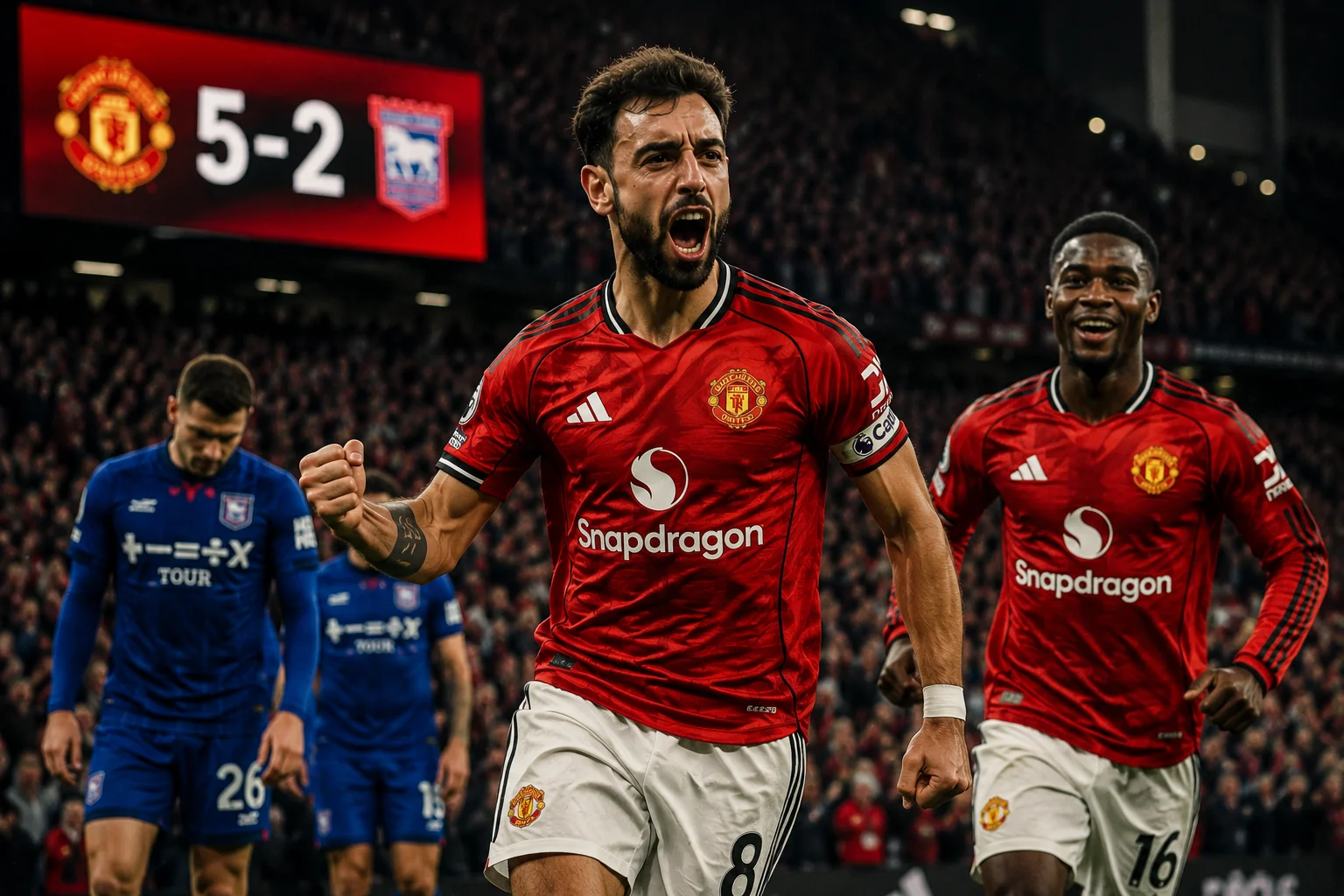
A week after losing at Hull City on the opening day, Manchester United needed a response. For half an hour at Old Trafford on 30 August they did not look like producing one. Then Bruno Fernandes took hold of the match, and by the end United had scored five, the captain had three of them and an assist for the fourth, and the Hull result looked like what it probably was: a bad afternoon rather than a sign of things to come.
This is how the match turned, and what it told us about Michael Carrick’s side.
How did Ipswich take the lead?
Through a well-worked goal that United’s defence did nothing to stop.
Ipswich, newly promoted under Gary O’Neil, started the brighter side and scored in the twenty-ninth minute. Abdul Fatawu beat Luke Shaw on the right and delivered a cross that Leif Davis finished. Moments later Davis had a better chance to make it two, but his effort was tame and Senne Lammens saved comfortably.
That miss mattered. A two-goal lead for a promoted side at Old Trafford, with the home crowd already restless after Hull, would have been a very different match.
What changed before half-time?
An Ipswich mistake, and Fernandes punishing it.
In the fortieth minute Marcelino Núñez slipped and gave the ball to Matheus Cunha, who played Fernandes through. The captain hit a fierce left-footed finish past Kjell Scherpen, his weaker foot, and the match was level. One error, one goal, and the mood of the ground changed completely.
Fernandes had been named the PFA Players’ Player of the Year that week, after a season of twenty-one Premier League assists, a record, alongside nine goals. The equaliser was the first sign that the goals might come more freely this year.
How did United take control?
Through a sequence of three goals in which Fernandes was involved in all of them.
Early in the second half United went ahead when Harry Maguire’s effort went in off Jacob Greaves for an own goal, after a VAR check for handball against Maguire was waved through. Greaves then brought down Cunha in the area, and Fernandes converted the penalty in the sixty-first minute, ignoring Scherpen’s attempts to put him off.
The hat-trick came in the sixty-eighth. Marcus Rashford, making his first Old Trafford appearance in a year and a half, saw a shot saved; the ball came back out off a deflected Bryan Mbeumo effort, and Fernandes was quickest to it from close range.
Was there more to come?
A fifth, and the assist was as good as any of the goals.
With eight minutes left Fernandes played Mbeumo in with a pass over the top, and Mbeumo chipped Scherpen, the ball going in off the underside of the bar. Three goals and an assist for the captain, four goal involvements in one afternoon, from a player whose previous season had been built on creating rather than scoring.
Ipswich had the last word, Chuba Akpom scoring in stoppage time after Jeremy Enciso won the ball and squared it, but the match had long been decided.
How did Old Trafford respond?
With relief first and then with noise, through a downpour heavy enough that the stadium roof struggled to cope.
The crowd had come expecting a reaction to Hull and had spent the first half hour watching the opposite. Fernandes’ equaliser changed the atmosphere immediately, and by the time of the penalty the ground was fully behind the team in a way it had not been a week earlier. Rashford’s return after so long away was warmly received, and the combination of a captain performing and a familiar face back on the pitch gave the afternoon a sense of the club putting itself back together.
What did the match say about United?
Two things, and they pull in opposite directions.
The attack is in good order. Cunha, Mbeumo and Rashford all contributed, Fernandes was decisive, and United scored five against a side that had defended reasonably well for half an hour. After the Hull defeat, that was the response the crowd needed, and the intensity was back.
The defence is less convincing. Ipswich scored twice, both from situations United should have handled, and the opening half hour was a reminder that promoted sides will find chances at Old Trafford if the home side is slow to start. A fine attacking display was bookended by defensive errors, and that pattern will need fixing against better opposition.
Where were the full-backs in all this?
Worth a look, because both of Ipswich’s goals and United’s opener came from wide areas.
Davis, Ipswich’s left-back, scored their first and was their most dangerous attacker for half an hour. Shaw was beaten for the cross that led to it. United’s own full-backs were quiet in the first half and far more involved after the break, as the side pushed higher and the wide areas opened up. Our piece on what makes a great Premier League full-back covers why that position decides more matches than it gets credit for, and this one was a fair example.
What does it mean for Ipswich?
A deserved lead, a creditable half hour, and a lesson in how quickly a promoted side can be overwhelmed.
Ipswich competed for long periods and O’Neil will have taken positives from the way his side played. But the match turned on one slip, and the gap in quality showed once United found their rhythm. Our piece on why promoted clubs struggle in the Premier League covers exactly this pattern: a promoted side plays well, makes one mistake, and the mistake costs far more than it would have in the Championship.
What about Carrick?
A manager who needed a result got one, and got it in the manner the club’s supporters wanted.
The Hull defeat had put pressure on Carrick early, and a poor performance against another promoted side would have made it worse. Instead his team came from behind, scored five and played with the intensity that had been missing. One match does not settle a manager’s season, but it changes the conversation around him, and for a manager at Old Trafford that is worth a great deal.
Why does Fernandes matter so much?
Because he is the player United’s whole attack runs through, and this match showed both halves of what he does.
Last season he created more than anyone in the league’s history. This season, at least on this evidence, he is adding goals. A playmaker who scores is the rarest and most valuable thing a side can have, and our piece on why the number 10 still matters explains why clubs build around that kind of player. Whatever number is on his back, that is the role Fernandes plays.
For the shirt itself, our guide to choosing between Manchester United’s home, away and third kits covers the range the captain scored in.
Frequently asked questions
Who scored for Manchester United against Ipswich?
Bruno Fernandes scored three, including a penalty, with Bryan Mbeumo adding the fifth and a Jacob Greaves own goal the second. Leif Davis and Chuba Akpom scored for Ipswich.
When was Manchester United v Ipswich played?
On Sunday 30 August 2026 at Old Trafford, the week after United’s opening-day defeat at Hull City.
Did Bruno Fernandes win Player of the Year?
Yes. He was named the PFA Players’ Player of the Year that week, after a record twenty-one Premier League assists the previous season.
Leave a Reply