
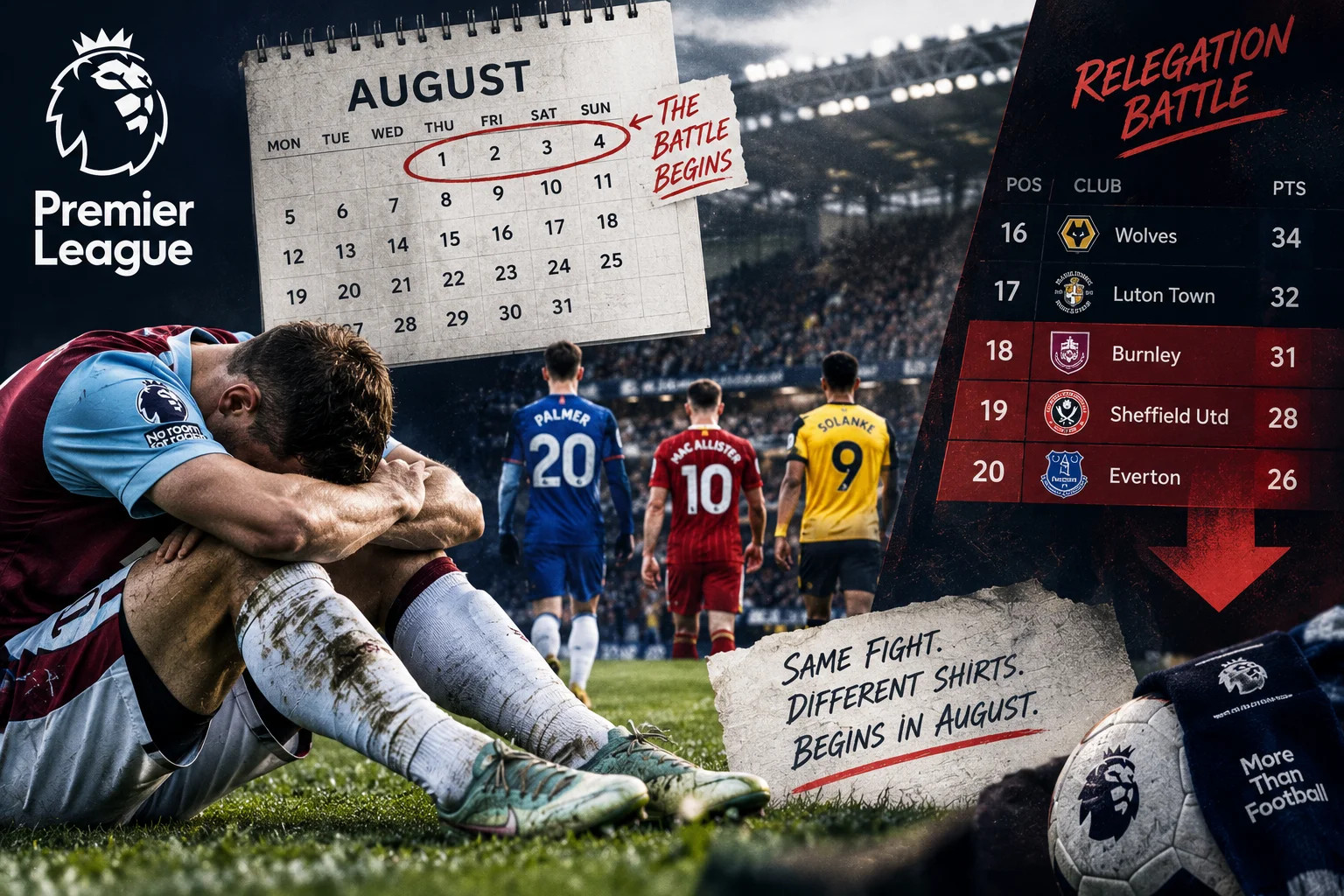
Relegation is remembered as a drama of the final weeks: the last-day scramble, the matches between the bottom clubs, the table that changes with every goal. But by the time those weeks arrive, the outcome has usually been shaped months earlier, by points won or lost in September when nobody was paying attention.
Understanding why explains how the bottom of the table actually works, and why the clubs that survive tend to do so by playing the whole season as though it were the run-in.
Why do early points count for more?
They do not, arithmetically. Psychologically and practically, they are worth a great deal.
A side that collects points early builds a cushion that lets it absorb the bad runs every season contains. A side that starts badly spends the rest of the year chasing, with every poor result tightening the pressure. The points are the same, but the state the club is in when it earns them is not. Clubs fighting from behind make panicked decisions, change managers mid-season and buy badly in January, and each of those compounds the original problem.
That is why experienced managers at the bottom talk about reaching a points total by a certain date. They are not superstitious. They are trying to buy themselves room to fail later.
How many points does survival take?
Fewer than people assume, most seasons.
The threshold for staying up has varied, but it has frequently sat in the mid-to-high thirties, and in some seasons sides have survived with less. That means a club needs to win roughly one match in three and draw a few more. Framed that way, survival is not about being good. It is about being consistently not bad, and avoiding the long runs without a point that sink most relegated sides.
The clubs that go down typically have a stretch of eight, ten or twelve matches without a win somewhere in their season. Avoiding that stretch is most of the job.
Which fixtures matter most?
The ones against the clubs around you, and the ones at home.
Matches between the bottom sides are worth more than their three points, because a win takes points from a direct rival as well as adding to your own. Managers circle them from the moment the fixture list is published. Home matches matter because home advantage is strongest for struggling sides, whose crowds know what is at stake and whose grounds become difficult to visit.
Away matches at the top clubs matter least. A side that loses at the big six and wins at home against its rivals stays up. A side that takes a famous point at a top club and then loses at home to the side one place below it is in trouble.
What do the survivors do differently?
They defend first, score from set pieces, and keep their nerve.
Almost every side that survives a relegation battle does so by being hard to beat rather than by attacking. Compact shapes, few goals conceded, points ground out from draws. Set pieces provide a disproportionate share of their goals, because set pieces depend on organisation and height rather than expensive talent, and those can be coached at any budget.
They also avoid panic. Changing the manager in the autumn after a poor start sometimes works and sometimes makes things worse, and the clubs that keep faith with a plan tend to do better than those that abandon it at the first bad run.
Why do promoted clubs face the hardest version?
Because they arrive with the smallest squads and the least experience of the fight.
A promoted club has a season to learn what the Premier League demands, and the learning happens in matches. Our piece on why promoted clubs struggle in the Premier League covers the gaps they face. In relegation terms, the critical one is depth: a promoted side can often field a competitive first eleven but cannot replace it when injuries arrive, and the mid-season weeks when the fixtures pile up are where their seasons are most often lost.
Why do some clubs go down with a good side?
Because a good side that loses its nerve, or its key players, or its shape, becomes an ordinary one quickly.
Sides relegated with squads that looked too good to go down usually share a pattern: an early-season injury to a key player, a manager who changed approach too often, or a dressing room that fractured once the pressure arrived. Talent on paper does not survive a ten-match winless run. The clubs that stay up with weaker squads are the ones whose squads stay intact and whose approach stays consistent.
How does the January window fit in?
As a chance to fix a specific problem, and a trap for clubs that try to fix everything.
A club in trouble that identifies one gap, a goalscorer or a centre-back, and fills it in January often improves. A club that signs five players and hopes some of them settle rarely does, because new players mid-season need time the club does not have. The sides that use January best are the ones that already knew what they needed in August.
Does a change of manager help?
Sometimes, and the timing decides it.
A new manager in the autumn, with most of the season left and a squad that has stopped responding to the old one, can turn a relegation battle around. The same change in March, with a dozen matches left and no transfer window, rarely does more than change the mood for a fortnight. The sides that sack managers late and survive usually do so because the squad was better than its results, not because of anything the new manager did.
The honest pattern is that the clubs with the clearest plan in August tend to need the fewest changes in March.
Why the final weeks still matter
Because the cushion built early can still be spent, and because the bottom sides so often meet each other late in the season.
The last-day drama is real. But the sides that find themselves in it are usually there because of what happened months earlier, and the side that survives is usually the one that arrived at the final weeks with the most points in hand, not the one that played best in May.
For the attacking approach that gets some sides out of trouble, our piece on the art of the counter-attack covers the tactic struggling sides lean on most.
The pattern is consistent enough to be a rule. Look at the bottom six in late October. Most seasons, two of the three relegated sides are already there.
Frequently asked questions
How many points do you need to stay up in the Premier League?
It varies by season but has frequently sat in the mid-to-high thirties, which means winning roughly one match in three plus some draws.
Why do relegated clubs usually go down?
Most relegated sides have a long run without a win somewhere in their season, often eight matches or more. Avoiding that run is most of what survival requires.
Are matches between bottom clubs more important?
Yes. A win against a direct rival adds three points to your total and denies three to theirs, which makes those fixtures worth more than their face value.
Leave a Reply