
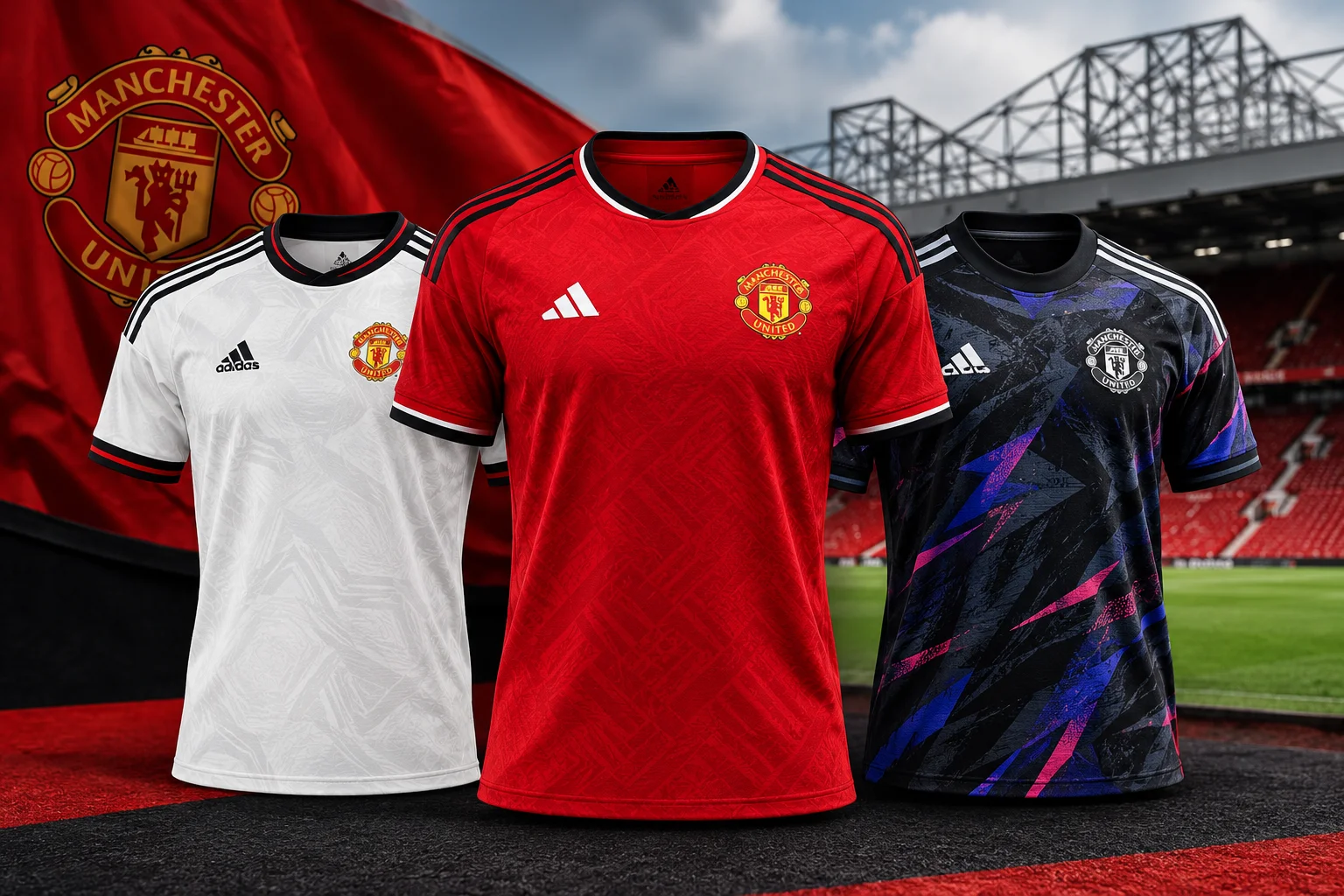
Every summer United release three shirts, and every summer a large number of people buy the red one without really considering the other two. That is a perfectly reasonable default. It is also, quite often, the wrong call.
The three shirts in a kit range are not simply the same garment in different colours. They are made in different quantities, they age at different speeds, and they hold their appeal for very different lengths of time. Knowing which is which changes what you end up with for the same money.
What actually changes on a United shirt each season?
Less than the marketing suggests, on the home shirt at least.
The red is fixed. The crest is fixed. The template underneath is usually shared with several other clubs on the same manufacturer’s books that year. What changes is the collar, the sleeve trim, and whatever small pattern or texture has been worked into the fabric. That is the whole of it, most years.
This is deliberate. The home shirt is the club’s most valuable single product, and radical change risks the people most likely to buy it. So the design effort goes into the away and third kits, where the commercial downside of an experiment is much smaller. That single fact explains most of what follows.
The home shirt and the red that is never quite the same red
United’s red has shifted subtly across the decades, and the shifts are more visible than people expect when two shirts from different years are held side by side. Dye formulations change, manufacturers change, and the intended shade is interpreted slightly differently each time.
None of that is a flaw. But it does mean you should look carefully at product photography, because a shirt that has drifted noticeably from the intended red is telling you about the quality control behind it. Sleeves that do not match the body, or collar trim in a different family of red, are manufacturing faults rather than design choices.
The home shirt’s real characteristic is that it ages slowly in appearance and quickly in status. Two years on it still looks entirely correct, but anyone who follows the club can date it immediately.
Are away shirts the better long term buy?
Usually, yes, and for reasons that have nothing to do with how they look on release day.
Away shirts change far more dramatically year to year. They use colours the club does not otherwise wear, they reference older designs, and occasionally they take a genuine risk. They are also produced in smaller numbers than the home shirt, which matters more than people realise.
The result is that a good away shirt stays distinctive. Five years on, it reads as a deliberate choice rather than as an out of date home kit. If you are buying one shirt and want to still want it in 2031, the away shirt is the stronger bet.
When away kits become collector’s items
The ones that hold value tend to share a few things: an unusual colour, a short lived sponsor, or a season that people remember for other reasons. Any of those makes a shirt easy to place and relatively rare, which is the whole basis of a shirt holding interest.
What to do if you buy one mid-season
Buying an away shirt in January or February is often the best value moment in the calendar. Stock is still available, the shirt is current, and reductions have usually begun. Waiting until spring gets you a better price again, but the popular sizes go first.
Third kits and who they are really for
Third kits exist partly for European competition and partly because clubs can sell a third shirt. They lean into colours and ideas the club would never risk on a home kit, and the results swing between excellent and baffling.
They sell in the smallest numbers of the three, which cuts both ways. Genuine scarcity if the design lands, and a shirt nobody else wanted if it does not. If this is your first United shirt, start elsewhere. If it is your fourth, the third kit is often the most interesting thing in the range.
Replica or player version: which fit suits you?
Two different garments, and the naming does not always make that clear.
The replica is the standard fan shirt, cut with some room through the chest and body, comfortable for a few hours in a stand. The player version is tighter, lighter and cut for someone running for ninety minutes, with noticeably less give across the shoulders.
The critical point is that they use separate size charts. Ordering a player version in your usual replica size is among the most common mistakes buyers make, and it is entirely avoidable. If a seller lists both, they should publish measurements for each.
How do you check a shirt is worth the money?
Three checks, and they work on any club’s kit.
The crest first. Embroidered or properly bonded crests last for years. Heat pressed badges lift at the corners within months of regular washing, and once a corner lifts the rest follows. Sellers who photograph the crest close up are confident in it.
Then stitching at the hem and sleeve cuffs, which carry more stress than anywhere else on the shirt and fail first. Even, dense stitching is what you want. Then fabric texture, which should be visible in a decent close up — match shirts use a light knit with structure, often with mesh panels. A completely smooth, flat surface generally means a cheaper base cloth.
People shopping for manchester united shirts across several seasons will find these three tells apply identically regardless of year or manufacturer.
Printing, numbering and the details people get wrong
Decide on printing before you order, not after. Adding it later means finding someone who does heat pressed vinyl locally, and matching the official font closely enough to look right is harder than it sounds.
Printing also makes the shirt non returnable in almost every case, since it has been made to your specification. So sizing stops being something you can correct later the moment you commit to a name on the back.
If you are printing a current player, remember squads move. A shirt printed in August with someone who leaves in January becomes a period piece. Plenty of people enjoy that. Worth knowing it is the trade you are making.
So which United shirt should you buy?
If you want the shirt everyone is wearing right now and you do not mind it dating, buy the home shirt. If you want something you will still reach for in five years, buy the away. If you already own several and want the one nobody else has, the third kit is where to look.
And whichever you choose, last season’s version is almost always the better value purchase. Twelve months old, near identical to most observers, and considerably cheaper.
Chelsea offer a useful contrast here, since their blue changes far more than United’s red — our guide to which Chelsea shirt season is worth buying goes through it. For the shirts that defined the club’s history rather than its present, our piece on United’s most iconic jerseys covers the classics.
Frequently asked questions
How long does a Manchester United shirt stay current?
One season, broadly. A new home shirt arrives each summer, with away and third kits on the same cycle. Last season’s shirt remains perfectly wearable and usually costs a good deal less.
Do replica and player version shirts use the same sizing?
No. The player version is cut tighter and lighter, with its own size chart. Ordering one in your usual replica size will almost always give you something too small across the chest and shoulders.
Is it worth buying last season’s shirt?
For most buyers, yes. It is twelve months old, close to indistinguishable to anyone not studying the collar, and substantially cheaper than the current equivalent.
Leave a Reply