
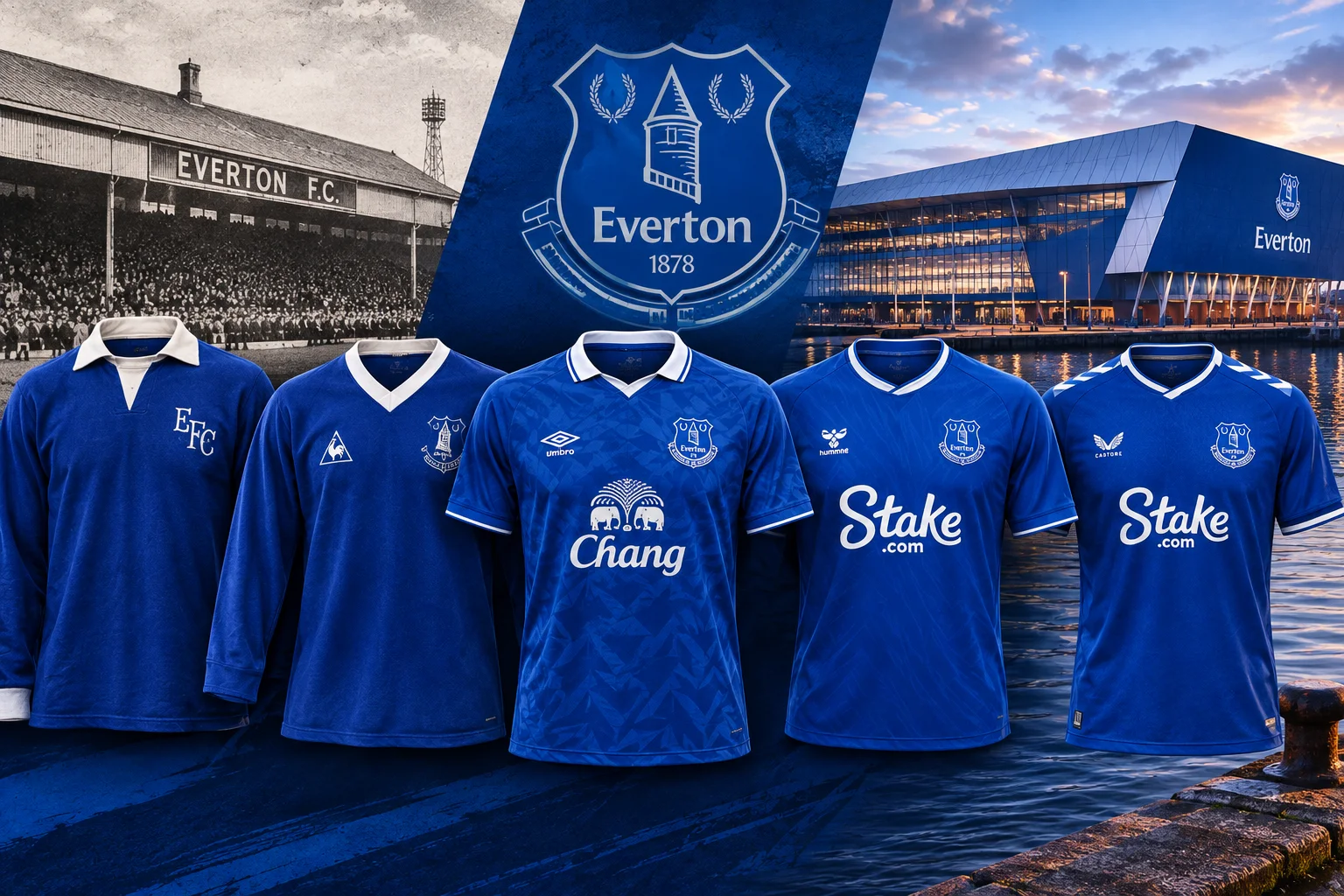
Everton have played in royal blue for 125 years, at Goodison Park for 133 of them, and as of August 2025 they play somewhere else entirely. The move to the Hill Dickinson Stadium at Bramley-Moore Dock is the biggest change in the club’s modern history, and the shirt has gone with it, redesigned for the new ground and worn by a team learning to call the waterfront home. This is the story of the Everton kit, from a church team on Stanley Park to a second season beside the Mersey.
A church team and a colour problem
Everton were founded in 1878 as St Domingo’s, the football team of a Methodist chapel in the Everton district of Liverpool, and changed their name a year later when players from outside the congregation wanted to join. This site takes its name from that chapel side, so forgive the soft spot. The early years were chaotic in kit terms: the club wore black shirts with a scarlet sash, the “Black Watch” strip, then ruby, then salmon and blue, before finally adopting royal blue shirts with white shorts in 1901. That combination has been the home kit ever since, with only the shade and the trim shifting from decade to decade.
Goodison Park, 1892
The club played at Anfield from 1884 until a rent dispute with landlord John Houlding split it in two. Houlding kept the ground and founded Liverpool; Everton crossed Stanley Park and built Goodison Park, which opened in 1892 as the first purpose-built football stadium in England. It went on to host a World Cup semi-final in 1966, nine league title celebrations and Dixie Dean’s 60-goal season of 1927/28, a record for a single English league campaign that has never been beaten and probably never will be.
Numbers on the back and a comeback at Wembley
Everton’s shirt has a claim on a small piece of football history. The 1933 FA Cup final against Manchester City was the first in which players wore numbers, and the two sides were numbered as one team: Everton wore 1 to 11, with Dean at number 9, and City wore 12 to 22. Everton won 3-0. Thirty-three years later the royal blue was worn for one of Wembley’s great recoveries, when Harry Catterick’s side came from 2-0 down to beat Sheffield Wednesday 3-2 in the 1966 final, Mike Trebilcock scoring twice in a game most supporters had already given up on.
The Holy Trinity and the mid-1980s
Two eras define the kit for older supporters. The first is 1969/70, when Harry Catterick’s champions, built around the midfield of Howard Kendall, Alan Ball and Colin Harvey known as the Holy Trinity, wore a plain royal blue shirt with a white crew neck. The second is the mid-1980s with Kendall as manager. The 1984/85 side that won the league and the European Cup Winners’ Cup wore a Le Coq Sportif shirt with the Hafnia logo, followed by the NEC shirts of the 1987 title and the 1995 FA Cup, when Paul Rideout’s header beat Manchester United at Wembley. Neville Southall, Graeme Sharp, Andy Gray and Kevin Sheedy all played in variations of those designs, and they remain the most reissued shirts in the club’s catalogue.
Sponsors and manufacturers since
NEC stayed on the front for a decade. Chang took over in 2004 and lasted thirteen years, which means a whole generation of supporters grew up assuming the Thai lager was part of the crest. Manufacturers rotated more often: Umbro, Puma, Le Coq Sportif again, Nike, Umbro again, Hummel from 2020, and Castore since the 2024/25 season. The constant through all of them has been the colour. Everton have flirted with lighter and darker blues and with white, yellow and black trim, but a royal blue body has never been up for negotiation.
The early 2020s were the hardest stretch in living memory. Two consecutive relegation battles under Frank Lampard and then Sean Dyche, points deductions for financial breaches and a stadium being built on borrowed money made the Hummel-era shirts a symbol of a club holding on rather than moving forward. The return of David Moyes in January 2025, eleven years after he left for Manchester United, steadied things just in time for the move.
Farewell to Goodison
On 18 May 2025 Everton played their final men’s first-team match at Goodison Park, beating Southampton 2-0 in front of a crowd that stayed long after the whistle. The ground has not been demolished. It is now the home of Everton Women, which softened the goodbye for a lot of families. The men’s team moved two miles along the road to the Hill Dickinson Stadium, a 52,769-capacity ground built on the Bramley-Moore Dock with the Mersey on one side and the city’s northern docklands on the other.
A kit for a new home
Castore’s 2025/26 home shirt was designed for the move. The wave pattern running through the royal blue was inspired by the River Mersey that now frames the stadium, a rare example of a kit designed around a ground rather than a season, and it was worn for the first competitive match at the new stadium, a 2-0 win over Brighton in August 2025. David Moyes, in his second spell as manager, guided the club to a thirteenth-place finish in that first season, the sort of settled campaign Everton had not managed in years, and he remains in charge for 2026/27. The new season opened at home to Crystal Palace after a summer of improvements to the stadium and a freshly relaid pitch. The adult replica shirt is priced at £80, which places it in the middle of the Premier League range.
What the new era means for the shirt
The Hill Dickinson Stadium changes the context of the kit more than the kit itself. Goodison’s tight stands and famous church corner made royal blue look old; the waterfront ground, all glass and brick, makes the same colour look modern. The 2025/26 shirt leaned into that, and the club’s training and warm-up range has already borrowed the docks, the Three Graces and the city skyline for its patterns. Expect the river to keep appearing in away kits and training wear for a while yet, while the home shirt stays exactly what it has been since 1901.
For a club that had come to feel stuck between its history and its ambitions, the move is a chance to be judged on the present rather than the past. The shirt, at least, was ready for it. For more Premier League news, match reports and club history, visit ST Domingos.
Leave a Reply