Every club has a shirt its supporters would recognise in the dark. Manchester United have about a dozen. Some are tied to a trophy, some to a player, and one to a half-time change of clothes in Southampton that the club would rather everyone forgot. This is a tour through the Manchester United jersey by era: the designs that mattered, why they mattered, and how the newest one reaches back almost fifty years for its inspiration.
Newton Heath: green and gold
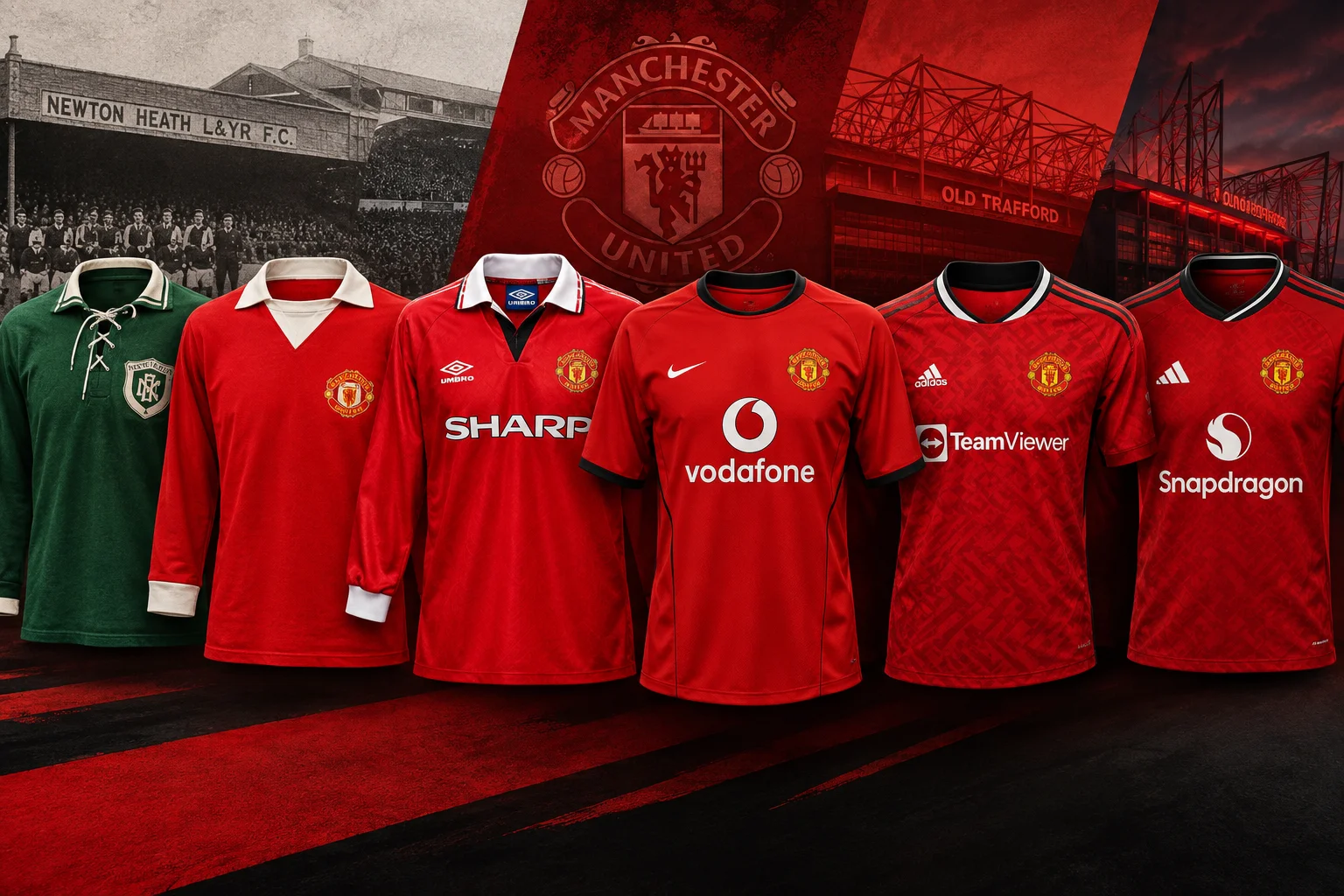
The club that became Manchester United was founded in 1878 as Newton Heath LYR, a works team for the Lancashire and Yorkshire Railway’s carriage and wagon department, and it played in the railway company’s colours of green and gold halves. Those colours vanished when the club was rescued from bankruptcy, renamed Manchester United and put into red shirts in 1902, but they never entirely left. Green and gold has returned as an away kit, as a protest scarf and, in 2018, as a train-track graphic along the hem of the home shirt to mark the club’s 140th anniversary.
1968: all blue at Wembley
The most important shirt in the club’s history is not red. On 29 May 1968, ten years after the Munich air disaster, Matt Busby’s side beat Benfica 4-1 at Wembley to become the first English club to win the European Cup, and because of a colour clash they did it in an all-blue kit with white trim. Bobby Charlton scored twice, George Best and Brian Kidd once each, and the blue shirt has been reissued so many times since that some supporters own more copies of it than of the red.
1975 to 1980: Admiral and the 1977 FA Cup
Admiral were the first manufacturer to put their own branding on a United shirt, and their late-1970s design, plain red with a white collar and cuffs trimmed in black, worn with white shorts and black socks, is the one Tommy Docherty’s team wore to beat Liverpool 2-1 in the 1977 FA Cup final and deny their rivals a treble. Stuart Pearson and Jimmy Greenhoff scored. That shirt matters more than ever this season, for reasons explained below.
The adidas and Sharp years
adidas took over in 1980 and stayed for twelve seasons, and in 1982 Sharp became the club’s first shirt sponsor, a partnership that ran for eighteen years and produced the most photographed United shirts of all. Norman Whiteside’s curling winner in the 1985 FA Cup final came in adidas red with the Sharp logo; so did Alex Ferguson’s difficult early years, the 1990 FA Cup that is generally credited with saving his job, and the 1991 Cup Winners’ Cup final in Rotterdam, where Mark Hughes scored twice against Barcelona to give Ferguson his first European trophy.
The away kits everyone remembers
United’s away shirts deserve a section of their own, because the early 1990s produced three in a row that supporters still hunt down. The 1990 to 1992 blue away kit with its white “snowflake” pattern was the first, followed in 1992 by a green and gold halved shirt with a lace collar that revived the Newton Heath colours for the first time in ninety years, and then the black away kit of 1993 to 1995, a shirt with a Sharp logo in gold that is remembered, a little unfairly, as the one Cantona was wearing at Selhurst Park in January 1995. Every one of them has been reissued.
Umbro, Cantona and the grey shirt
Umbro replaced adidas in 1992 and immediately produced a classic: the 1992 to 1994 home shirt with a lace-up collar, worn turned up by Eric Cantona as United won their first Premier League title in 1993 and the Double in 1994. Umbro also produced the least loved shirt in the club’s history. On 13 April 1996, trailing 3-0 at half-time at Southampton, United changed out of their grey away kit into blue and white because, Ferguson explained, the players could not pick each other out against the crowd. They still lost 3-1, and the grey shirt was never worn again.
The same manufacturer made the shirt of the 1999 treble: a plain red home design with a white collar and the Sharp logo in its final years, worn at the Camp Nou as Teddy Sheringham and Ole Gunnar Solskjær scored in stoppage time against Bayern Munich. It is the reference point for every United retro shirt since, and the one most often copied.
Nike, Moscow and the Chevrolet era
Nike made United’s kits from 2002 to 2015, a period covering the Vodafone and AIG sponsorships and the 2008 Champions League final in Moscow, won on penalties against Chelsea in an AIG shirt. Aon followed, and it was in a Nike shirt with the Aon logo that Ferguson collected his thirteenth and final league title in 2013 before retiring. Chevrolet arrived in 2014, and adidas returned in 2015 on a deal that has produced some of the club’s better modern designs, with TeamViewer on the front from 2021 and Snapdragon from the 2024/25 season. The years since Ferguson have been thin on trophies, which is one reason the shirts of this era are judged more harshly than they deserve.
2026/27: a polo collar and a fifty-year nod
Which brings us to the newest shirt. adidas’s 2026/27 home kit is built on a clean red base with a polo collar and striped cuffs that directly reference the shirt worn in the 1977 FA Cup final, marking the fiftieth anniversary of that win over Liverpool. The three stripes and branding are white, black detailing is kept subtle, and a “United” sign-off sits on the back of the neck. It is completed with white shorts and black socks, exactly as Admiral did it, and it is the shirt United will wear with Champions League football back at Old Trafford.
In pricing terms it sits at £85 for the adult replica, level with most of the established top clubs, so the shirt is not the cheapest way to show your support. The design, though, is the club’s best in some years: a lesson in how to use heritage without turning a modern kit into fancy dress.
Which one is the greatest?
Ask ten United supporters and you will get ten answers: the 1968 blue for what it represents, the 1977 Admiral for the collar, the 1993 lace-up for Cantona, the 1999 shirt for Barcelona. What connects them is restraint. United’s best shirts have been red, simple and confident, and the club’s worst mistakes, the grey, a few of the busier third kits, happened when someone tried too hard. The new one understands that, which is a good sign for the season ahead. For more Premier League news, match reports and club history, visit ST Domingos.
Leave a Reply