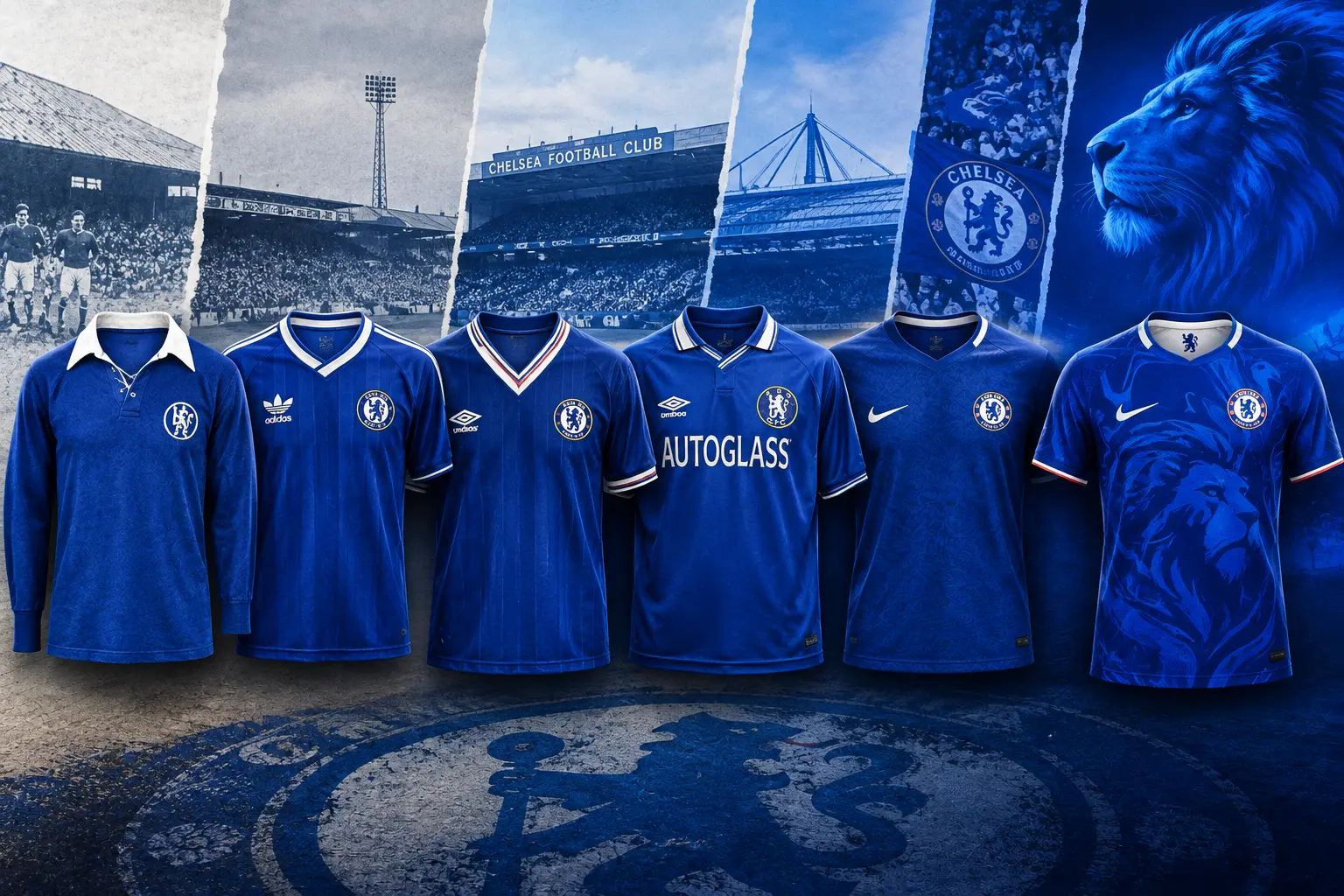
Few shirts in English football are as instantly recognisable as Chelsea’s: royal blue, white trim, a lion on the chest. It has looked that way for so long that it is easy to assume it always did. It didn’t. The Chelsea shirt has been redrawn more often than most supporters realise, and each version says something about the club at that moment: who owned it, who managed it and what it was trying to become. This is the story so far, decade by decade.
1905 to 1912: Eton blue and the Earl’s racing colours
Chelsea were founded in March 1905 in the Rising Sun pub opposite Stamford Bridge, a ground that already existed and needed a team to fill it. The first shirts were not the royal blue we know but Eton blue, a pale, almost mint shade, because those were the racing colours of the club’s first president, the Earl of Cadogan. Paired with white shorts and dark socks, the pale blue lasted around seven years before the club switched to a deeper royal blue in 1912. That decision has held for more than a century, although the original shade resurfaces every so often in away kits and anniversary designs.
1952 to 1971: Ted Drake, the lion and the first silverware
The modern identity was built by Ted Drake. When the former Arsenal centre-forward took over as manager in 1952, he retired the “Pensioners” nickname, adopted “the Blues” and replaced the Chelsea Pensioner crest with a rampant lion holding a staff, borrowed from the Cadogan family’s coat of arms. Three years later Chelsea were champions of England for the first time, winning the 1954/55 title in a plain blue shirt with a simple white collar.
The 1960s brought Tommy Docherty’s young side and a League Cup in 1965, and the era ended with the club’s most celebrated shirts of the period: the plain blue worn by Peter Osgood, Charlie Cooke and Alan Hudson as Chelsea beat Leeds in a replayed FA Cup final at Old Trafford in 1970, then Real Madrid in Athens to lift the European Cup Winners’ Cup in 1971. Those uncluttered designs are the template for most of the retro shirts sold today.
The 1980s: sponsors, pinstripes and Le Coq Sportif
Shirt sponsorship arrived in English football in the early 1980s and Chelsea’s first partner was Gulf Air, whose name appeared for the 1983/84 season. The kits of that era were made by Le Coq Sportif, and the pinstriped shirt worn as John Neal’s team of Kerry Dixon, Pat Nevin and David Speedie won the Second Division title in 1984 remains a favourite. Later in the decade the Commodore logo took over the front, followed briefly by Amiga, as the club settled into a long relationship with Umbro that lasted until 2006.
1994 to 2005: Coors, Autoglass and the cup years
For many supporters the golden age of Chelsea shirts is the mid-1990s. Glenn Hoddle, then Ruud Gullit and Gianluca Vialli, brought Gianfranco Zola, Roberto Di Matteo and Frank Leboeuf to west London, and they played in Umbro shirts carrying the Coors logo from 1994 to 1997. The 1997 FA Cup was won in that shirt, Di Matteo scoring inside the first minute against Middlesbrough at Wembley. Autoglass replaced Coors and saw out the League Cup and Cup Winners’ Cup double of 1998 and the FA Cup of 2000, the last final played at the old Wembley. Emirates arrived in 2001 and was on the front when Roman Abramovich bought the club in 2003.
2005 to 2017: Samsung, adidas and Munich
José Mourinho’s first title in 2005 came in an Umbro shirt with Samsung Mobile across the chest, and Samsung stayed for a decade. adidas took over manufacturing in 2006, which means the shirts worn for the 2010 league and cup Double and the 2012 Champions League final in Munich, Didier Drogba’s late header and the winning penalty, were all adidas designs. A second Mourinho title in 2015 was Samsung’s final season; Yokohama Tyres replaced them, and Antonio Conte’s champions of 2017 wore the last adidas Chelsea shirt before that contract was ended several years early.
2017 to 2025: Nike, Porto and a world title
Nike arrived in 2017 on a long-term agreement. Three replaced Yokohama as sponsor in 2020, and it was in a Nike home shirt that Kai Havertz scored the only goal of the 2021 Champions League final against Manchester City in Porto. The 2022 change of ownership brought a period of shirts without a settled sponsor, but the collection gained something more valuable in the summer of 2025 when Chelsea won the expanded Club World Cup in the United States. The gold winners’ badge has been on the shirt ever since.
2026/27: 75 seasons of the lion
Which brings us to the current shirt. Nike’s 2026/27 home kit takes a Bright Blue base and weaves an enlarged version of the crest into the fabric itself as a tonal pattern, so the lion is everywhere rather than confined to the chest. The collar is a button-down polo, the accents on the lion badge, swoosh and piping are in a shade Nike calls Midwest Gold, and the white socks carry a laurel wreath motif that also circles the crest. The club is marking the 75th season since Drake introduced the lion, and it is the first Chelsea shirt built with Nike’s Aero-FIT ventilation.
The launch was unusual too. Rather than a single reveal, the shirt was spotted in the wild on golfer Justin Rose at the PGA Championship and on other famous supporters weeks before the official release. It is also the first shirt of the Xabi Alonso era. After a season that saw two managers dismissed and an FA Cup final defeat to Manchester City, the Spaniard began work on 1 July with a four-year contract and a squad badly in need of stability.
What the changes tell us
Strip away the sponsors and manufacturers and the Chelsea shirt has really only changed twice: from Eton blue to royal blue in 1912, and from the Pensioner to the lion in 1953. Everything since has been variation on a theme, wider collars, pinstripes, a gold accent here and there, and that consistency is exactly why the shirt is so recognisable at a hundred paces. The best designs, from 1970 to 1997 to 2012, are the ones that trusted the blue to do the work. Time will tell whether the gold-trimmed lion of 2026/27 earns a place alongside them, but it has at least started with a story to tell. For more Premier League history, kit features and match coverage, you can find everything on ST Domingos.
Leave a Reply