
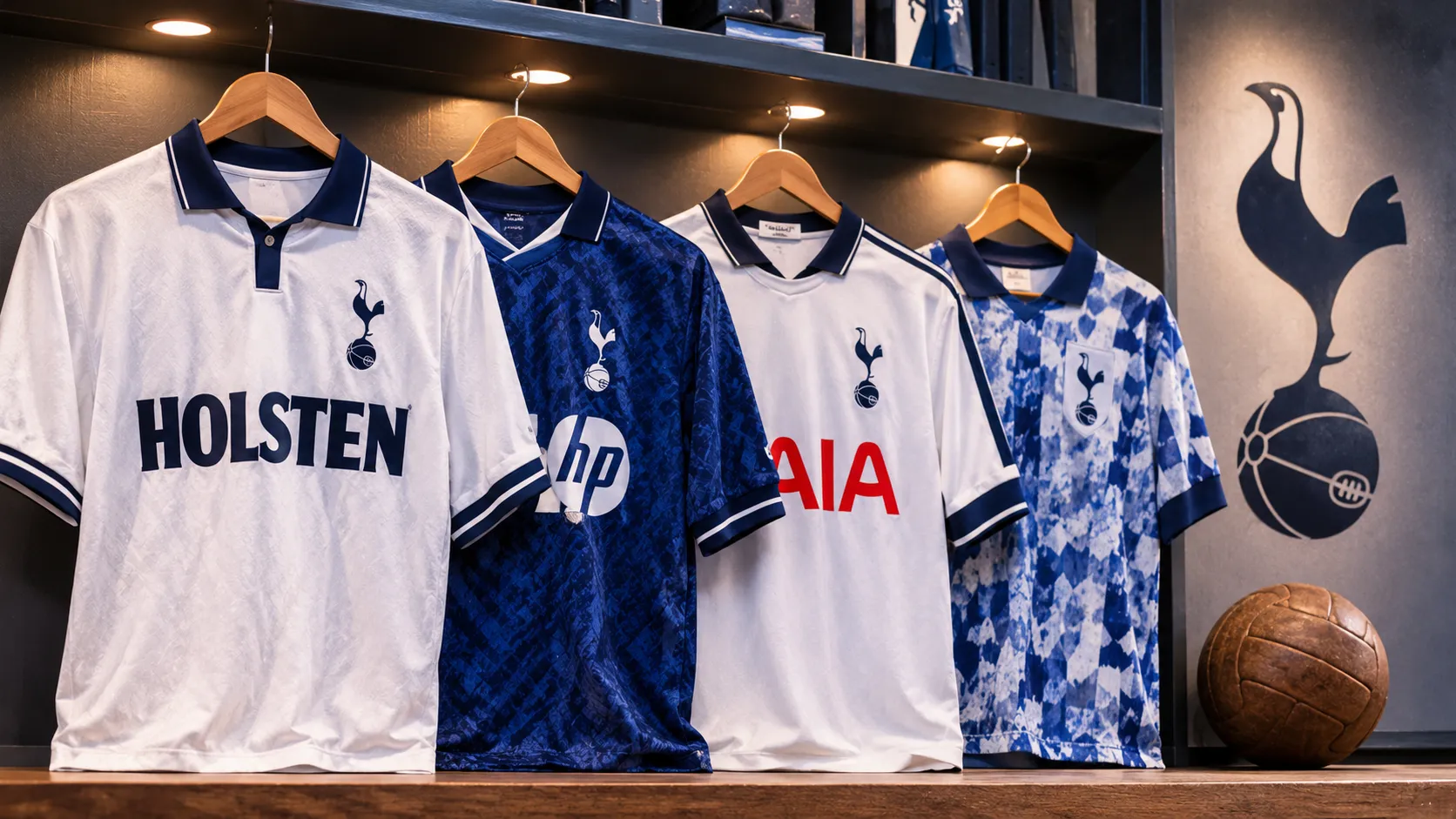
Tottenham have one of the longest unbroken visual identities in English football. White shirt, navy shorts, a cockerel on the chest worn in essentially that form since the early years of the twentieth century. For a collector that consistency is both the appeal and the problem: the shirts are beautiful and they all look alike in a thumbnail.
Which means dating a Spurs shirt is a skill rather than a glance. The information is all there in the collar, the badge treatment, the sponsor and the trim but you have to know where to look. This guide runs through the eras, explains what distinguishes each, and sets out the checks worth running before you buy.
Why a plain white shirt is harder to collect
A club with a busy design history gives you obvious markers. A striped shirt changes stripe width; a patterned shirt changes pattern. Spurs give you a white shirt with a badge, and the differences between one decade and the next are measured in centimetres of collar and millimetres of embroidery.
That has two consequences. The first is that the sponsor becomes the single most useful dating tool, far more so than at most clubs, because it is the only large element on the front that changes. The second is that poor reproductions are unusually hard to spot from a photograph there is no pattern to misalign, so the giveaways are all in construction.
It also means a Spurs shirt from almost any era still looks current, which is the collector’s compensation. A white shirt does not date the way a nineties shadow-stripe does.
The pre-sponsor era
Everything before shirt sponsorship arrived in English football is the purest version of the design: white, a crest, nothing else. These are the shirts most often reproduced badly, because a maker can get the look right with almost no effort and the details wrong without anyone noticing in a listing photograph.
What separates a faithful reproduction here is fabric and collar. Period shirts were made from substantially heavier material than anything produced today, with a visible weave, and they used specific neck constructions laced early on, then buttoned or pointed collars that are expensive to replicate. A plain white shirt in thin modern polyester with a crew neck is a modern blank, whatever the listing calls it.
The badge is the other tell. Early crests were simpler than the modern mark and were often applied rather than embroidered directly, and the cockerel’s shape has been redrawn more than once.
The sponsored decades
Once sponsors arrived, dating gets much easier. Each deal ran for a defined period, so the name across the chest narrows a shirt to a handful of seasons immediately, and the supplier’s logo on the sleeve or chest narrows it further.
Work in that order every time: sponsor first, then maker, then collar shape, then crest treatment. Those four together will place almost any Spurs shirt within a season or two. A listing where they disagree a sponsor from one era with a crest from another is either a fake or a seller working from a stock image, and both are reasons to walk away.
This is also the period where the alternatives get interesting. With the home shirt locked to white, Spurs’ away and third kits have been through navy, sky blue, yellow, black and various combinations, and those are where the design work happened. They are also cheaper, because demand is lower, which makes them good value if you want a specific season without paying home-shirt money.
Which Tottenham retro shirt should you start with?
Pick a season you remember rather than the season a forum says is significant. A shirt attached to a memory gets worn; a shirt bought because it was recommended sits in a drawer.
If you have no particular season in mind, the pre-sponsor white shirt is the one that will look right longest, because it is the design stripped to its essentials. If you want something with more character, the alternatives from the late eighties and nineties have the strongest following, and good tottenham retro shirts from that period turn up regularly without commanding the prices the home shirts do.
How do you check a reproduction is any good?
Four checks, in this order. Hold the badge at arm’s length: on a well-made shirt the cockerel and the ball beneath it are distinct, and on a poor one the embroidery is dense and the shape blurs into a lump.
Then the collar. Period neck constructions are the first thing a cheap reproduction simplifies, so a shirt claiming to be from an era of pointed or buttoned collars that arrives with a plain ribbed crew has been made to a price.
Then the lettering, if the shirt carries a number. Each era had its own font and the digit shapes are distinctive enough that a wrong one is obvious once you have seen the right one.
Then the fabric, which you can only judge in the hand. Older shirts feel substantial and slightly rough; a reproduction that feels slippery and light has been printed onto a modern garment. For the wider version of these checks across any club, our football shirt buying guide covers the rest.
The alternatives, which are where the value is
With white fixed at home, Tottenham’s design freedom went entirely into the away and third shirts, and that is where the back catalogue gets interesting. Navy, sky blue, yellow and black have all had turns, some of them repeatedly, and the results range from genuinely elegant to firmly of their decade.
For a buyer that variety is an advantage twice over. The alternatives were produced in smaller numbers, so they are more distinctive to own, and they sell for noticeably less because demand concentrates on the home shirt. A season-specific away shirt frequently costs half what the home shirt from the same year does.
The one caution is identification. Away kits were sometimes launched mid-season and occasionally carried a different sponsor arrangement from the home shirt, so match the sponsor and supplier to the specific year rather than assuming they ran in step.
Sizing, and why your usual size will not behave
Retro cuts are boxier through the body and shorter in the sleeve than modern shirts, because that is how shirts were made. A faithful reproduction in your normal size will feel wider and shorter than you expect, and that is correct rather than a fault.
Measure a shirt you already own flat across the chest, armpit to armpit, and compare that figure to the seller’s measurements. Ignore the size letter entirely it means different things at different makers and nothing at all on a reproduction of a sixty-year-old garment.
What to avoid
Three things. Listings with stock photography rather than the actual item, because you cannot check a badge you have not seen. Sellers who will not photograph the inside of the neck, where the labels are. And any shirt described as both a reproduction and an original, which is a contradiction and usually a deliberate one.
Also be wary of a reproduction priced close to an original. The two are different products serving different buyers, and a reproduction at collector prices is someone hoping you will not know the difference. Captaincy and squad numbers are their own rabbit hole, and we look at the first of those in what makes a good captain.
Frequently asked questions
How do I date a Tottenham shirt?
Sponsor first, then the supplier’s logo, then the collar shape, then the crest treatment. Those four together place almost any Spurs shirt within a season or two.
Are Tottenham’s away shirts worth collecting?
Often better value than the home shirts. With the home design fixed, the alternatives carried all the design risk, and they sell for less because demand is lower.
Why do retro shirts fit differently?
They follow the original cut, which was wider through the body and shorter in the sleeve. Buy on chest measurement rather than the size label.
Is a heavier fabric a good sign?
Generally yes. Period shirts were made from thicker material with a visible weave, so a reproduction that feels substantial has been made with the era in mind.
Leave a Reply