
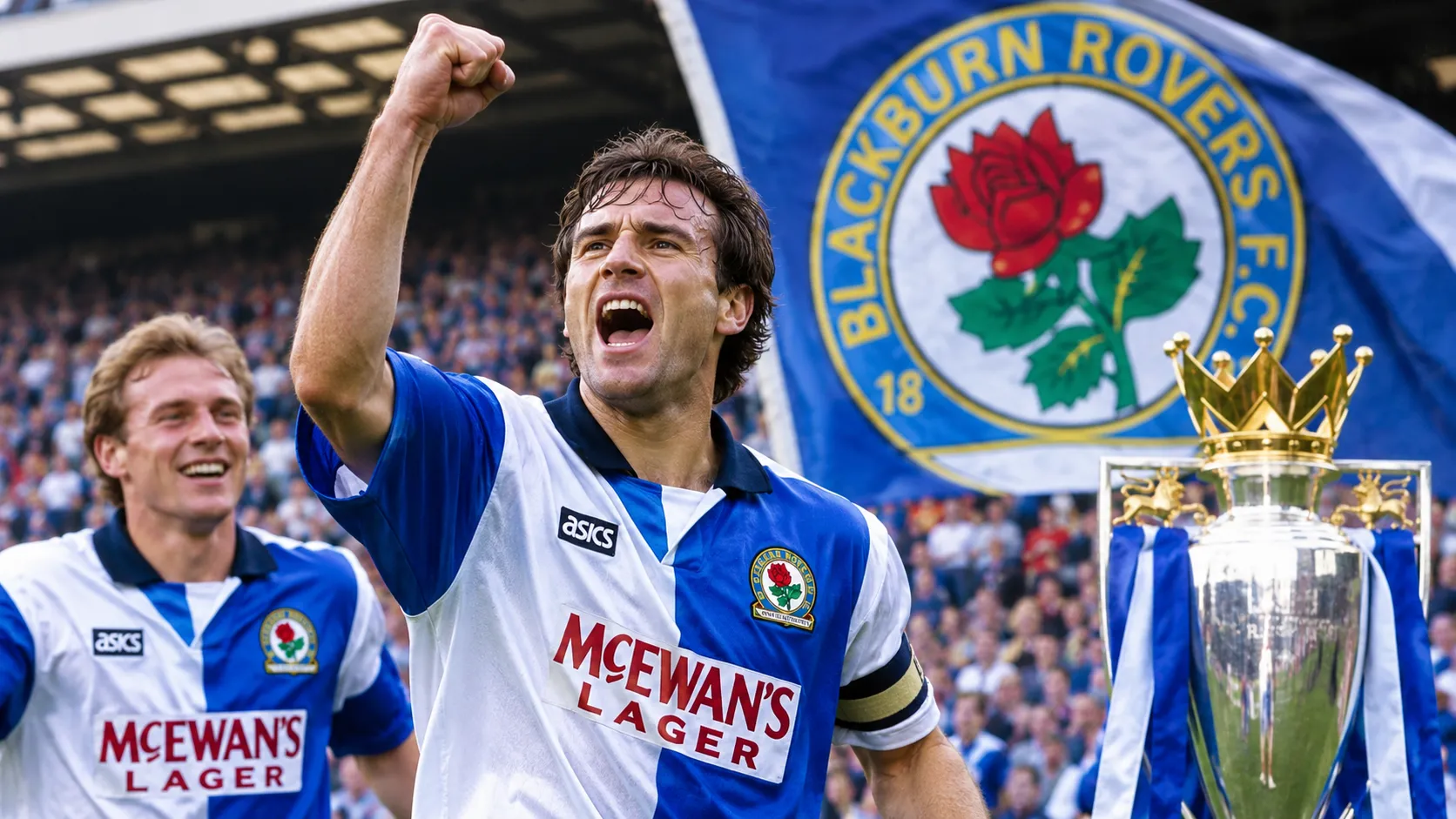
Almost all demand for blackburn rovers retro shirts concentrates on a single season. Rovers won the Premier League in 1994-95, three years after promotion, and in doing so became the only club outside the established elite to take the title in the competition’s modern era. Everything the shirt means is attached to that.
It is also a story that could not happen now, which is a large part of why people still want the shirt.
What actually happened
Jack Walker, a local steel magnate who had supported the club since childhood, bought Rovers in 1991 when they were a second-division side with a crumbling ground. He funded a rebuild of Ewood Park and, more significantly, funded a transfer policy that no club of that size had ever attempted.
Kenny Dalglish was appointed manager, Alan Shearer was signed from Southampton for a British record fee in 1992, and Chris Sutton arrived from Norwich for another British record in 1994. The two of them became the SAS partnership and scored the goals that won the league.
Shearer’s thirty-four league goals in the title season remain one of the great individual campaigns in English football. The Premier League holds the records from that era, and the scoring figures from it still stand comparison with anything since.
The final day
Blackburn went to Anfield on the last afternoon needing a result, and lost 2-1 to Liverpool. They won the title anyway, because Manchester United could only draw at West Ham on the same afternoon and finished a point behind.
That is the detail that makes the story: the champions lost their final match, at the ground of the club their own manager had won everything with as a player. Dalglish was photographed on the pitch at Anfield being congratulated by Liverpool supporters, which is an image that would be unimaginable today.
The margin was one point across thirty-eight games. Nothing about it was comfortable, and the side spent the run-in dropping points it had not needed to drop.
Why did it never happen again?
Because the economics closed. Walker’s spending was enormous relative to Blackburn’s revenue but small in absolute terms, and at that moment a wealthy local owner could genuinely outspend the biggest clubs in England.
Within a decade, broadcast money had scaled the top of the league far beyond anything a single benefactor could match from his own pocket, and the financial rules that followed made it harder still. A club of Blackburn’s size cannot now assemble a squad capable of winning the league, however motivated the owner.
What followed for Rovers was the other half of the lesson. Relegation in 1999, a return and a League Cup win in 2002, then a long decline that eventually took the club into the third tier. The title shirt sits in the middle of a club history that is mostly not about titles.
The shirt itself
Blue and white halves, which is one of the more distinctive designs in English football and almost nothing like a striped shirt in how it photographs. The halved pattern makes alignment at the seams unusually obvious, which is useful for anyone judging a reproduction.
The title-season shirt is the one most reproduced and most faked. It is also simple enough that a good reproduction gets close, and the markers that separate a good one from a bad one are the usual four: crest detail, collar construction, number font and fabric weight.
Check the halves meet cleanly at the shoulder and down the side seam. On a shirt assembled from printed panels there is almost always a step where the two colours meet, and on a halved design you cannot miss it.
Which season should you actually buy?
The title shirt is the obvious answer and not always the right one. It is the most reproduced, the most faked and the most worn, which means it is also the least distinctive thing to own if you turn up at Ewood Park wearing one.
The seasons either side are more interesting. The 1993-94 shirt belongs to the side that finished second and was clearly building towards something, and the 1995-96 shirt is from the title defence, which went badly and is therefore barely remembered. Both are cheaper and both have better stories than a casual observer realises.
The away shirts from the mid-nineties are the real value. Smaller production runs, less demand, and designs that were often bolder than the home kit because the halved pattern leaves a designer very little room to work with. A good away shirt from that period costs a fraction of the title shirt and is far harder to find in decent condition.
If the point is the title specifically, buy the home shirt. If the point is the era, look wider.
Dating a Rovers shirt
Sponsor first, as always, then supplier, then crest, then collar. Rovers have been through a sequence of sponsors that map tidily onto eras, and the club’s crest with the rose and the motto has had several treatments.
One extra marker specific to this club: the Premier League sleeve patch. Rovers have moved between divisions several times, so the presence or absence of a top-flight patch narrows a shirt considerably on its own, in a way it would not for a club that has never been relegated.
Sizing follows the usual retro rule. Nineties cuts were generous through the body and long in the sleeve, so a faithful reproduction will feel bigger than a modern shirt in the same nominal size. Measure across the chest rather than trusting the label, as our football shirt buying guide sets out.
Is it worth buying?
If you want a shirt attached to a story, this is one of the best in English football a genuine outlier, a season nobody expected, and a club that has never come close since. That is a better reason to own a shirt than most.
As an object it is also well priced. Nineties replicas were produced in large numbers, so originals from the period are not scarce, and reproductions are inexpensive. It is one of the few genuinely famous shirts you can buy without paying a famous-shirt premium.
The away and third kits from the same era are cheaper still and more interesting to own, for the usual reason: smaller production runs and lower demand. Set pieces decided a lot of matches in that side, which is covered in what makes a great free-kick taker.
What to check before you pay
Three things, in order. Condition of the crest, because embroidery degrades first and a crest with loose threads or a lifted edge drags the value of everything else down with it.
Condition of the printing, if there is any. Nineties heat-transfer numbers crack and peel, and a shirt with a Shearer 9 that is half missing is worth considerably less than a plain one in the same state. Flex the print gently; if it is going to crack, it will show.
Fabric around the armpits and the hem, which is where sweat damage and stretching concentrate. Hold the shirt up to a light and look for thinning rather than holes, because thinning is what comes before the holes.
Frequently asked questions
When did Blackburn Rovers win the Premier League?
In 1994-95, three years after promotion, funded by local owner Jack Walker and managed by Kenny Dalglish. They remain the only club outside the established elite to win the competition.
Who were the SAS?
Alan Shearer and Chris Sutton, both signed for British record fees, who scored the goals that won the title. Shearer scored thirty-four league goals that season.
Did Blackburn win the title on the final day?
Yes, despite losing 2-1 at Anfield. Manchester United drew at West Ham on the same afternoon and finished a point behind.
How do I date a Blackburn shirt?
Sponsor, supplier, crest and collar as usual plus the Premier League sleeve patch, which narrows it quickly because the club has moved between divisions several times.
Leave a Reply