
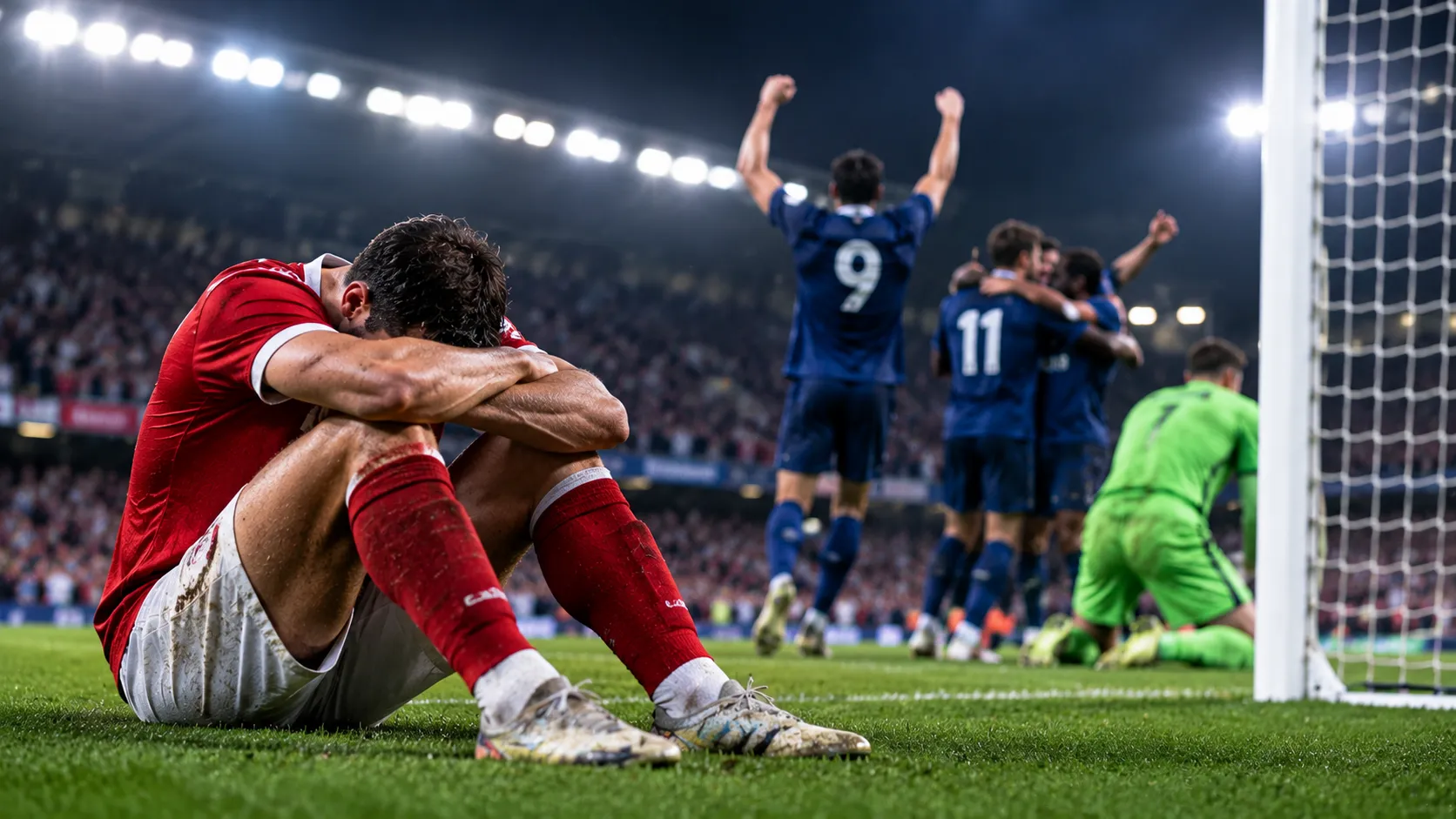
Every supporter believes their club is uniquely bad at defending leads. Most of them are wrong, because late goals are far more common than the sense of grievance suggests, and they happen for reasons that are structural rather than characterological.
Goals are not distributed evenly across ninety minutes. They cluster late, in every league, every season, and have done for as long as anyone has counted. Understanding why turns an apparently random cruelty into something fairly predictable.
Goals genuinely do cluster late
Across the major European leagues, the final fifteen minutes of a match produce more goals than any other fifteen-minute segment, and the opening fifteen produce the fewest. That pattern is remarkably stable, which tells you it is caused by something about how matches develop rather than by chance.
Three things drive it. Players are tired, so the physical and mental errors that create chances become more frequent. The game state has usually resolved into something asymmetric, with one side protecting and the other committing. And substitutions have introduced fresh attackers against defenders who have run for eighty minutes.
None of those is a failure of character. They are the normal consequences of a football match running its course.
Fatigue, and what it actually degrades
Not running, mostly. Players cover similar total distance late in a match as early. What falls off is the high-intensity work the sprints, the recoveries, the second and third efforts and defending depends on exactly those.
More importantly, fatigue degrades decision-making before it degrades movement. A tired defender makes the right choice slightly later, which is the difference between stepping out to intercept and being caught between two options. A tired midfielder tracks one runner and not the second. Those are the errors that produce late goals, and they are cognitive rather than physical.
Concentration is the related problem. A defensive shape holds because eleven people maintain their positions relative to each other for ninety minutes, and that is an attentional task. The lapse that leads to a late equaliser is usually one player switching off for three seconds.
Why does protecting a lead make it harder to keep?
Because the instinct to defend deeper is self-defeating past a certain point. A side that drops its line to the edge of its own box has given up the territory where it can relieve pressure, so every clearance comes straight back, and the defending gets progressively more desperate.
It also changes what the attacking side is allowed to do. An opponent who no longer fears a counter-attack can push its full-backs high and commit a centre-half into the box, which is a risk it would never take at nil-nil. The leading side has, in effect, licensed the pressure it is now struggling to survive.
The sides that defend leads well do the opposite of what instinct suggests: they keep the ball when they win it rather than clearing it, and they keep a forward high to make the opponent’s defenders think twice. That is a coached behaviour, not a brave one.
Substitutions cut both ways
Five changes have made the last twenty minutes a different game. A side chasing a result can introduce three attackers at once without weakening itself the way it once would, and fresh attackers running at tired defenders is the single most productive late-game pattern in football.
The side defending has the same five changes available and generally uses them worse, because the options are less obvious. Replacing a tired defender mid-siege introduces someone cold into the most pressurised phase of the match, and a substitute who has been sitting for an hour is both physically unprepared and unfamiliar with how the game has developed.
This is why late goals have, if anything, become more common rather than less. The rule that was meant to manage load also handed the chasing side a weapon.
Added time changed the maths
Stoppage periods are now considerably longer than they were, because the laws are applied as written celebrations, substitutions and review delays are all counted. A board showing seven minutes is routine where it was once remarkable.
That is simply more football, played at the point in a match when goals are most likely. A side defending a lead now has to survive a passage that may be half as long again as it used to be, with fresh opponents and nothing left in its own legs. The rise in late goals that followed the change was entirely predictable. The Premier League publishes match data that shows the distribution clearly.
What actually reduces it
Keeping the ball, keeping a forward high, making substitutions before the siege rather than during it, and treating the last ten minutes as a phase to be coached rather than endured. Sides that are good at this are noticeably good at it season after season, which is the strongest evidence that it is a skill rather than luck.
The other half is squad depth, because every one of those solutions requires players capable of executing it while tired. A side whose bench cannot change a game is a side that has to hold on, and holding on is the approach least likely to work. For the shirt rather than the football, our guide to Tottenham retro shirts is a better use of a Tuesday evening, and why promoted clubs struggle covers who suffers from this most.
The opposite problem: scoring late
The same forces work in reverse, and the sides that concede least late are rarely the same ones that score most late. Scoring in the final fifteen is largely a function of having attackers fresh enough to run at tired defenders, which means a strong bench and a manager willing to use it early enough for the changes to matter.
That is why late goals are distributed unevenly across a league rather than randomly. Clubs with squad depth score more of them and concede fewer, and the gap compounds across a season into several points which is a meaningful share of the difference between finishing fourth and seventh.
For a supporter the practical read is simple. A side that keeps conceding late usually has a bench problem rather than a character problem, and the fix arrives in a transfer window rather than in a team talk.
Which sides are actually good at this?
The ones that treat it as a phase with its own plan, and they are identifiable season after season which is the strongest argument that it is coachable rather than lucky.
The markers are consistent. They make their changes at seventy rather than eighty-five, so substitutes are introduced before the pressure arrives rather than into the middle of it. They keep a forward high even when defending, accepting that one fewer body in the box is worth the doubt it creates in the opposition’s full-backs. And they keep the ball when they win it, taking the ten seconds of possession rather than the clearance, which is both the simplest and the hardest of the three.
The sides that are repeatedly poor at it usually share one of two problems: a bench that cannot change the game, so the manager has no lever to pull, or a coaching approach that treats the last ten minutes as a test of character. Character is not a tactic, and a side relying on it is relying on the one thing that fails fastest when players are tired.
Frequently asked questions
Are late goals actually more common?## Frequently asked questions
Are late goals actually more common?
Yes. The final fifteen minutes produce more goals than any other segment of a match, consistently, across every major league.
Is conceding late a sign of poor fitness?
Rarely. Total distance covered holds up late in matches; what declines is high-intensity work and decision speed. It is closer to a concentration and game-management issue than a conditioning one.
Why does dropping deeper not work?
Because it surrenders the territory needed to relieve pressure and removes the counter-attacking threat that was keeping the opponent honest. Clearances come straight back.
Has longer added time increased late goals?
It has increased the amount of football played at the moment goals are most likely, so yes more stoppage time means more late goals, which is what the data shows.
Leave a Reply