
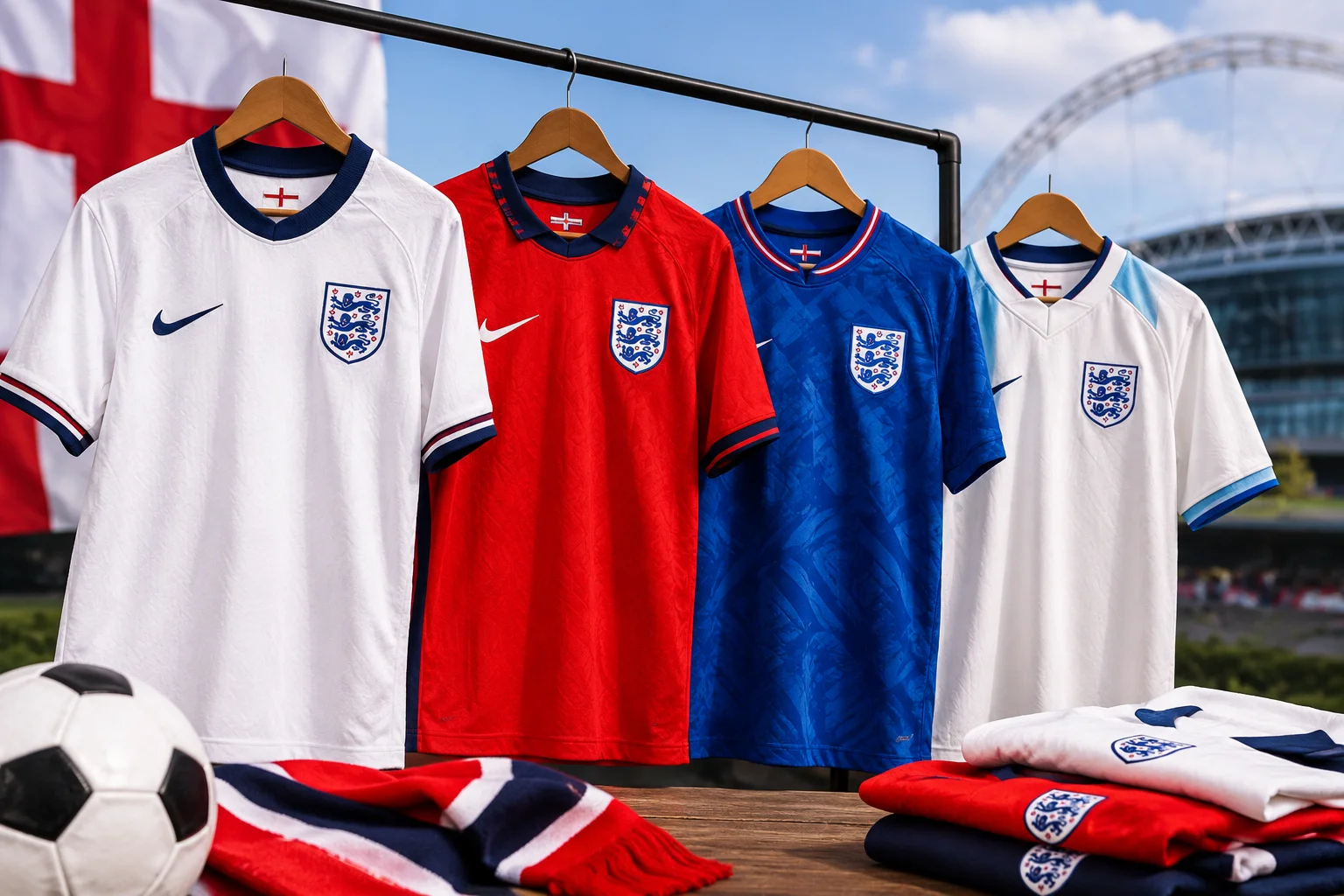
Club shirts change every summer. England shirts do not. The national team’s kit runs on a different rhythm entirely, tied to tournaments rather than seasons, and that changes almost everything about how to buy one well.
It affects when the price drops, how long a shirt stays current, and which older designs are worth hunting for. Most buying advice written for club kits gets these things wrong for international ones.
How does the England kit cycle actually work?
Around tournaments, in blocks of roughly two years.
A new home shirt typically arrives ahead of a major tournament and stays in use until the next one approaches. The away shirt follows the same pattern, sometimes offset by a year. That means an England shirt is current for far longer than a club shirt, which is replaced every twelve months whether anything has changed or not.
For a buyer this is good news. A shirt bought early in a cycle stays the current shirt for a long time, and the pressure to replace it is weaker than with any club kit.
When do England shirts drop in price?
The year after a tournament, and it is more reliable than the spring reductions on club kits.
Demand peaks in the months before and during a tournament, when interest in the national team is highest. Once it ends, demand falls sharply and sellers are left with stock they know will be superseded before the next one. That is when reductions arrive.
So the cheapest moment to buy the current shirt is usually the autumn or winter after a summer tournament. The most expensive is the early summer before one.
Which older England shirts hold their value?
The ones people remember, which for England means the ones tied to a tournament that meant something.
A shirt worn at a tournament where England went deep, or produced a famous match, stays in demand for years. A shirt from a cycle where the team went out early, or did not qualify, tends to be forgotten regardless of how it looked. That is unusual. For club shirts, design usually matters more than results. For England shirts, results matter more than design.
Away kits are the exception. England’s away shirts have historically carried the bolder design ideas, and several are collected for how they look rather than what happened in them.
What separates the home shirts from each other?
Less than you might think, and that makes dating them harder than dating a club shirt.
England’s home shirt is always white with some arrangement of navy or red trim, and the changes between cycles are confined to the collar, the trim placement and small details in the fabric. Without a sponsor on the front, one of the most useful markers on a club shirt is missing.
The manufacturer’s logo and the crest treatment are the main clues. The Three Lions crest has been rendered in several distinct ways over the decades, and combined with the collar style it usually narrows a shirt to a single cycle.
What should you check on a white shirt?
White hides nothing, which makes the checks easy to run from a photograph.
Opacity first. On a mannequin, the fabric should not show the form underneath. If it does, the knit is lighter than a decent shirt should be. Then panel consistency, since the white at the sleeves should exactly match the body. Then the crest, where a heat pressed badge shows a faint rectangular outline on white that an embroidered one does not.
Anyone comparing england football shirts across sellers should also look hard at the red or navy trim edges. Red is one of the least stable dyes and bleeds into white readily if not fixed properly.
Replica or player version for an international shirt?
The same distinction applies as with club kits, and the same mistake gets made.
The replica is the standard fan shirt, cut with room and built to survive repeated washing. The player version is lighter, tighter, uses more aggressive ventilation and is designed for someone playing ninety minutes rather than watching them. They use different size charts, and ordering a player version in your usual replica size gives you something too tight across the chest almost every time.
For most buyers the replica is the right choice. It is more comfortable, more durable and usually cheaper, and the performance advantages of the player version mean nothing in a stand or a pub.
How do you get the size right?
Measure rather than guess. Take a shirt you already own and like the fit of, lay it flat, and measure straight across from one armpit seam to the other. That half chest figure is what almost every size chart uses, and matching it to the chart is far more reliable than picking the letter you usually wear.
On a white shirt, if you are between sizes, the larger is the safer choice. A close-fitting white shirt shows more through the fabric than a dark one.
Kids’ shirts follow the same cycle
Children’s England shirts are released alongside the adult kit and run for the same two-year block, which makes them a better long-term buy than most club shirts for children, who will have grown out of a club shirt long before it goes out of date anyway.
Sizing is by height range rather than age, and the height figure is far more reliable than the age label on the listing.
Are England away shirts a separate market?
Increasingly, yes, and it is worth knowing if you are buying for interest rather than for wearing.
Where the home shirt is constrained to white, the away shirt has carried the design experiments: reds, blues, and some colours with no obvious connection to England at all. Several away shirts are now more sought after than the home shirts from the same cycle purely for how they look. They are also produced in smaller numbers, which compounds the effect over time.
The short version
Buy in the autumn after a tournament, not the summer before one. Expect the shirt to stay current for two years. Older shirts are worth having if the tournament was memorable, and away shirts are worth having if the design was. And check the white for opacity and the trim for bleed before you pay.
For the club side of this, our guide to choosing between United’s home, away and third shirts covers how a club range differs from an international one.
One last practical point. Because England shirts stay current for two years, the second-hand market is deeper than for club kits. A shirt from the current cycle bought used is still the current shirt, and it will usually cost a fraction of the new price with a season of wear that is invisible from a metre away.
Frequently asked questions
How often does the England football shirt change?
Roughly every two years, with new kits released ahead of major tournaments rather than every season like club shirts.
When is the cheapest time to buy an England shirt?
The months after a summer tournament ends, when demand drops and sellers reduce stock ahead of the next cycle.
How do I tell which year an England shirt is from?
Use the manufacturer’s logo and the crest style first, since there is no sponsor to help. The collar and trim placement narrow it further within a manufacturer’s period.
Leave a Reply